



Md Asiuzzaman | Career Educator & International Students Advisor
The global labour market is in a constant state of flux, shaped by powerful forces ranging from technological breakthroughs to geopolitical shifts. The World Economic Forum’s “Future of Jobs Report 2025” provides a comprehensive examination of these transformations, drawing on a unique dataset from a survey of over 1,000 global employers, representing more than 14 million workers across 22 industry clusters and 55 economies. This report provides critical insights into the evolving job landscape, required skills, and workforce strategies for the 2025-2030 period.
The Global Labour Market Snapshot in 2025
As of early 2025, the global economic outlook is stabilizing, with a projected growth rate of 3.2% for 2025 and easing inflation; however, the cost of living remains elevated worldwide.
Here’s a closer look at the current state:
- Unemployment Rates: The global unemployment rate stands at 4.9%, marking its lowest point since 1991. However, significant disparities persist. While unemployment is decreasing in middle-income countries, it’s increasing in low-income countries (from 5.1% in 2022 to 5.3% by 2024). Furthermore, the women’s unemployment rate (5.2%) has remained higher than the men’s (4.8%) since 2020, particularly in lower-middle-income countries. Youth unemployment is also a significant concern, with a global rate of 13%, rising to 27.6% in low-income economies.
- The “Jobs Gap”: The International Labour Organization’s “jobs gap,” which encompasses both unemployment and underemployment, indicates a need for 402 million additional jobs in 2024. This gap has been shrinking globally but has unfortunately increased in low-income economies, with pronounced gender differences in these regions.
- Labour-Force Participation: Encouragingly, the global labour-force participation rate has rebounded to 2019 levels across most income groups. This rebound is particularly notable in lower-middle-income economies, which are expected to drive the majority of working-age population growth, underscoring the critical need for job creation in these regions.
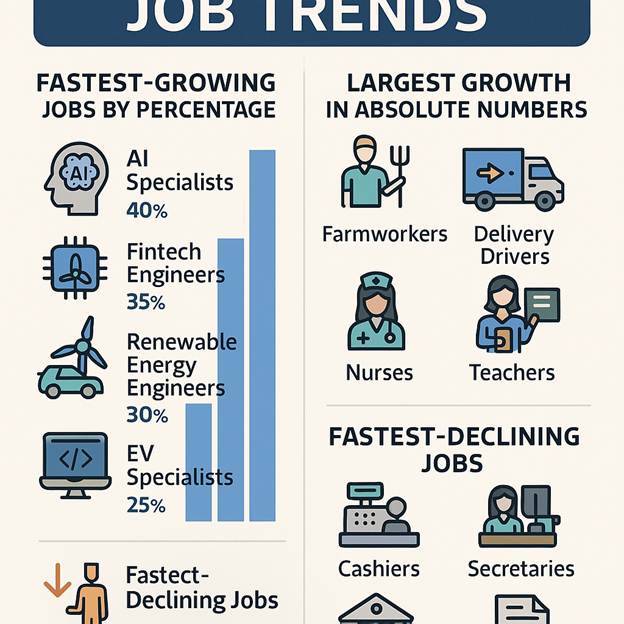
Five Major Trends Shaping the Future (2025-2030)
The report identifies five powerful macrotrends that are expected to reshape the global labour market by 2030:
1. Technological Change: The Digital Wave
Technological advancements are undoubtedly the most transformative driver. Broadening digital access is anticipated to transform 60% of employers’ businesses. The most impactful technologies are:
- AI and information processing technologies, which 86% of respondents expect to transform their businesses by 2030.
- Robots and autonomous systems are expected to transform 58% of businesses.
Generative AI (GenAI), in particular, is viewed as a significant enhancer of human skills and performance, potentially empowering a wide range of professionals. However, there’s a crucial caveat: if GenAI development isn’t focused on augmentation, it poses a risk of replacing human work, which could exacerbate inequality and unemployment. Demand for GenAI training has seen substantial growth, especially in India (corporate sponsorship) and the United States (individual users).
2. Green Transition: Towards a Sustainable Workforce
The urgency of environmental concerns is profoundly impacting the job market:
- Climate-change mitigation is the third-most transformative trend overall, affecting 47% of employers.
- Climate-change adaptation ranks sixth, influencing 41% of employers.
These trends are fueling demand for “green jobs,” such as renewable energy engineers and environmental engineers, as well as an increasing focus on environmental stewardship skills. The industrial sector, including Automotive and Aerospace, as well as mining and Metals, anticipates significant transformation due to decarbonization efforts.
3. Geoeconomic Fragmentation: Navigating a Divided World
Geoeconomic fragmentation and geopolitical tensions are expected to drive business model transformation in one-third (34%) of surveyed organizations. Increased restrictions on trade and investment (23%) and subsidies/industrial policies (21%) are also reshaping operations. This environment is increasing the demand for security-related roles (e.g., Security Management Specialists, Information Security Analysts) and crucial human-centred skills, such as resilience, flexibility, and leadership. Notably, employers expecting geoeconomic transformation are more inclined to re-shore operations (14.5% versus a 9.5% global average).
4. Economic Uncertainty: Cautious Optimism and Job Dynamics
While most chief economists (54%) expect economic conditions to hold steady in the short term, caution prevails.
- Slower economic growth is the only macrotrend anticipated to result in more job destruction (3 million jobs) than creation (2 million jobs).
- Conversely, the rising cost of living is expected to create 4 million jobs while displacing 3 million.
5. Demographic Shifts: Adapting to Changing Populations
Demographic changes present distinct challenges and opportunities:
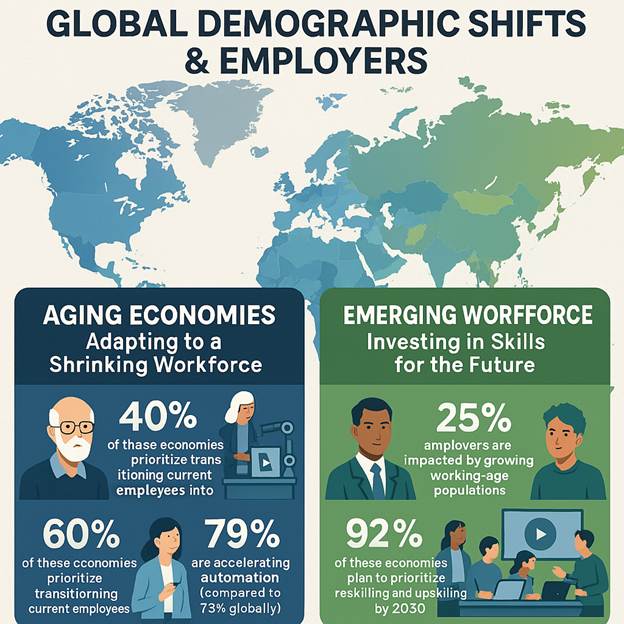
- Aging and declining working-age populations are transforming 40% of employers globally. These economies are increasingly prioritizing the transition of current employees into growing roles (60%) and accelerating automation (79%) to address talent availability challenges.
- Conversely, 25% of employers are affected by growing working-age populations. Economies with growing working-age populations plan to prioritize reskilling and upskilling, with 92% focusing on these strategies by 2030.
Conclusion
The “Future of Jobs Report 2025” presents a picture of a global labour market undergoing a profound and multifaceted transformation. From the rapid adoption of AI to the urgent shift towards green economies and the complexities of geopolitical and demographic changes, businesses and workers alike must adapt. Understanding these key trends is crucial for navigating the evolving world of work and preparing for the opportunities and challenges that lie ahead.
(The author is a career development professional in Canada. Multiple AI tools are used in researching, analysis and writing.)