


Md Asiuzzaman | Career Educator & International Students Advisor
The integration of Artificial Intelligence (AI) in the workplace is more than just a tech upgrade; it represents a significant shift in the job market. The World Economic Forum’s (WEF) Future of Jobs Report 2025 emphasizes this change. The future of work now relies heavily on active skill development. For both individuals and organizations, reskilling and upskilling are crucial for success in the AI era.
The Looming Skill Disruption
Rapid changes in the job market mean today’s skills have a short lifespan. The WEF report reveals that 39% of workers’ skills are likely to become outdated between 2025 and 2030. This “skill instability” necessitates a commitment to continuous learning. Although the rate of disruption has slowed, especially with more workers completing training, risks remain, particularly in lower-income economies.
The positive takeaway is that the risk of complete job loss due to AI is low. The report shows that none of the 2,800 skills analyzed have a “very high capacity” for replacement by current Generative AI (GenAI). This highlights GenAI’s role in enhancing human work through collaboration, not replacement. The focus should now be on how to work effectively alongside AI.

The Essential Skills for the Future
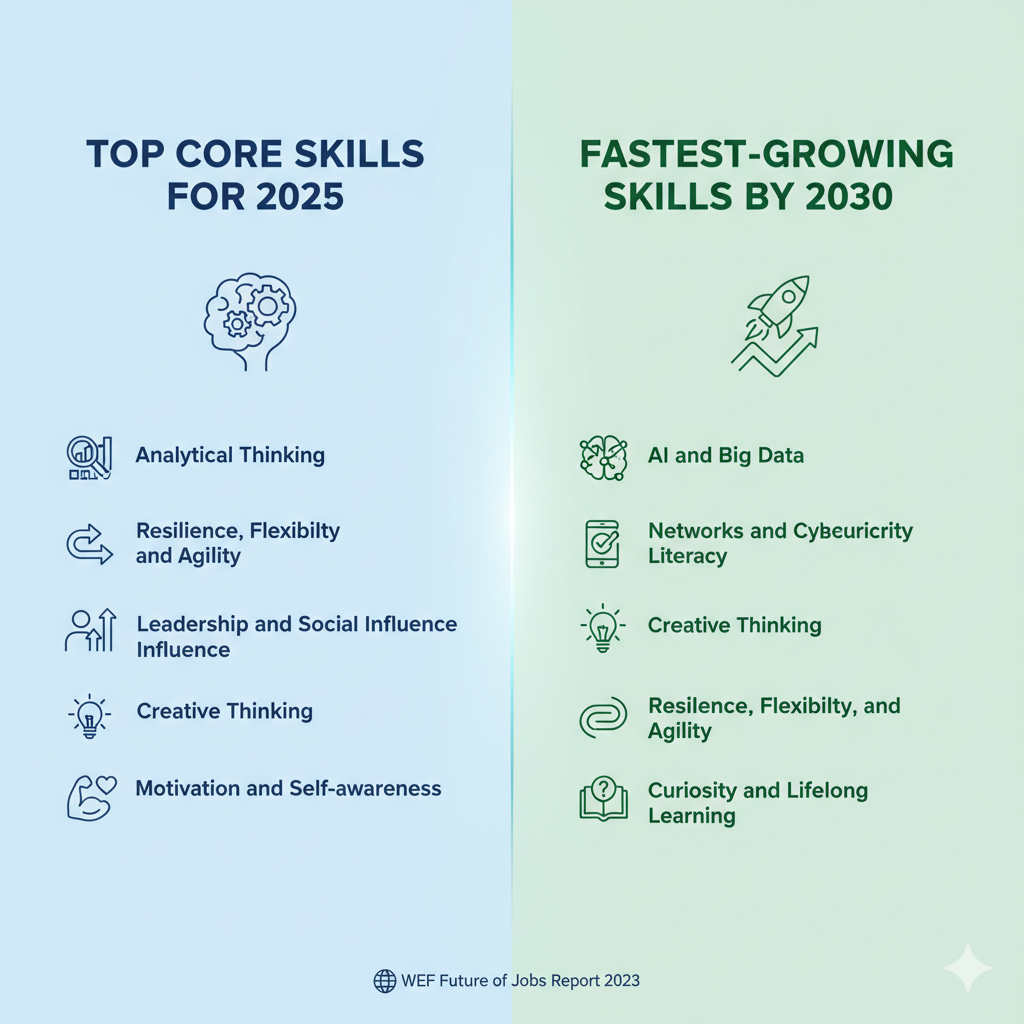
As technology automates routine tasks, uniquely human skills will be crucial. A recent report highlights analytical thinking as the top skill, valued by 70% of surveyed companies.
Key Skills for 2025:
- Analytical Thinking
- Resilience, Flexibility, and Agility
- Leadership and Social Influence
- Creative Thinking
- Motivation and Self-awareness
These human-centred skills, such as empathy, active listening, curiosity, and a commitment to lifelong learning, are critical alongside growing technical expertise.
The Rise of Technical and Adaptive Skills
Tech skills are becoming essential. The fastest-growing skills focus on AI and big data. Other key areas include networks, cybersecurity, and tech literacy.
Fastest-Growing Skills by 2030:
- AI and Big Data
- Networks and Cybersecurity
- Technological Literacy
- Creative Thinking
- Resilience, Flexibility, and Agility
- Curiosity and Lifelong Learning
Notably, environmental stewardship has made its debut in the top 10. This reflects a shift towards sustainability in society.
On the contrary, skills like manual dexterity and precision are likely to decline. Cognitive skills such as analytical thinking and self-efficacy will be crucial for emerging job opportunities.
Training and Retraining: The Path to Adaptation
Employers now understand that adaptation must not be the sole responsibility of employees. The workforce completing training has increased to 50%, up from 41% in 2023.
By 2030, 59 out of every 100 workers will need training. This includes 29 for upskilling in current roles and 19 for reskilling into new positions.
Employers have clear goals for their training investments. They expect to see boosts in productivity (77%), competitiveness (70%), and improved talent retention (65%).
The Future of Jobs Report 2023 sends a clear message: the job market will favour those who continually learn. Focusing on AI fluency and essential human skills is crucial. Success lies not in fearing AI, but in learning to work with it.