



Md Asiuzzaman | Career Educator & International Students Advisor
Canada has been a top choice for international students, known for its high-quality education and friendly environment. However, recent policy changes, especially the cap on international student permits and adjustments to post-graduation work permit eligibility, have caused major disruptions in the country’s higher education system. These changes have created a perfect storm, leading to significant job losses, revenue shortfalls, and a sharp decline in international student enrolment.
Let’s break down the facts and figures and explore what this means overall.
The Rationale Behind the Cap: Addressing the Housing Crisis and More
Starting early 2024, the Canadian government implemented a two-year cap on international student permits. The decision stemmed from concerns about the housing crisis and the pressure on public services. The rapid growth in international student numbers was seen as worsening housing shortages and affordability problems in major cities.
The government aimed to manage growth and ensure international students receive proper support. But the critics believe that international students were unfairly blamed for a complicated housing issue stemming from a long-term housing crisis. Some experts also think the cap was a way to respond to public concerns about immigration by appearing tougher on entry.
A Dramatic Drop in International Student Numbers
The effect on international student enrolment has been immediate and severe:
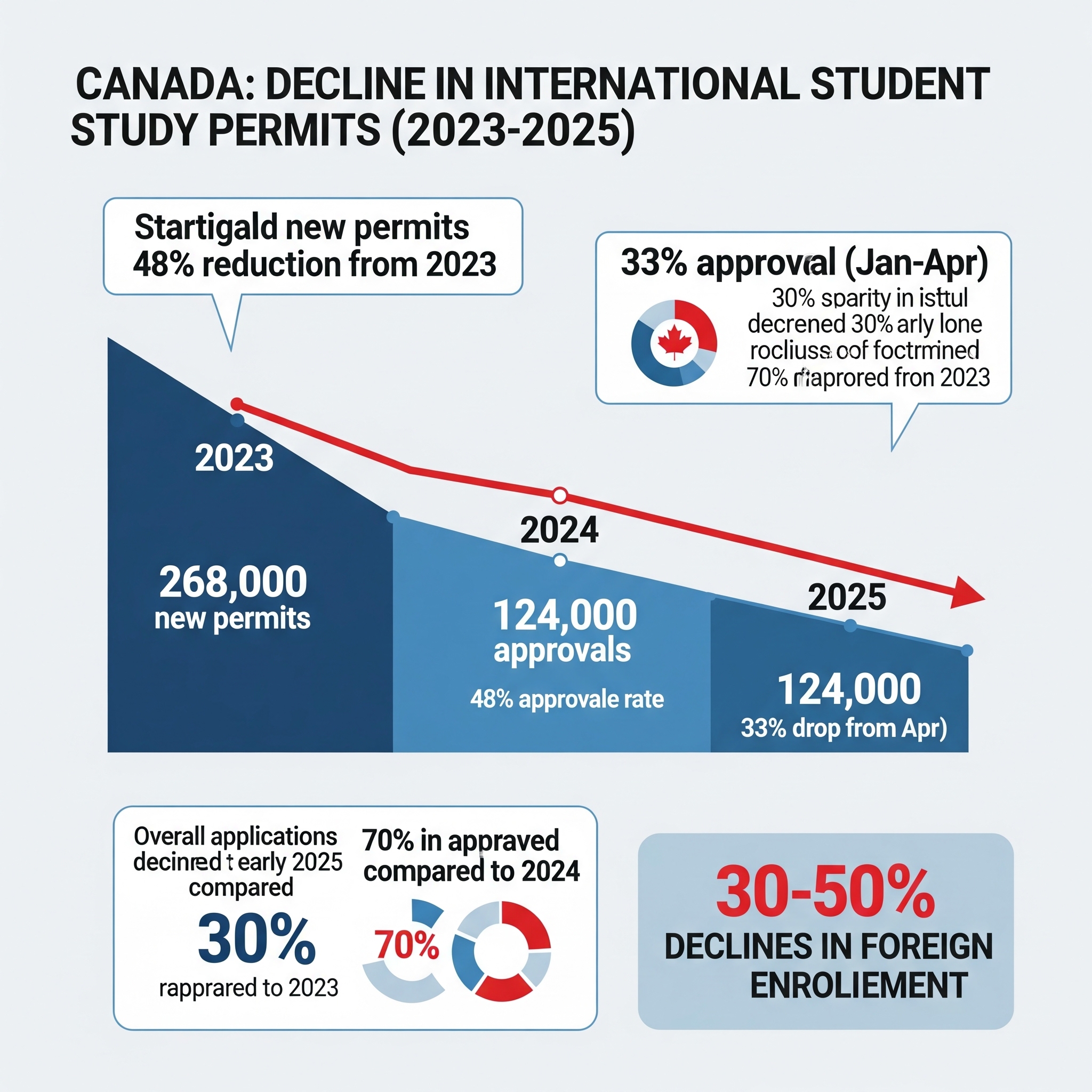
2024: Canada issued just under 268,000 new study permits, a shocking 48% drop from 2023. This number was almost 100,000 below the official target set by Immigration, Refugees and Citizenship Canada (IRCC). The approval rate for new study permits dropped from 59.8% in 2023 to 48% in 2024.
2025 Projections: The outlook for 2025 is even more alarming, with new study permit approvals expected to be around 124,000. This means a 50% drop from 2024 and nearly 70% less than 2023. The approval rate for new study permits fell to 33% in January–April 2025, leading to fewer than 31,000 approvals in the first four months of the year—about a 70% year-over-year drop.
Declining Applications: Interest in studying in Canada is falling, with new study permit applications down 30% in early 2025 compared to 2024 and a significant 70% compared to 2023.
Overall Impact: Many institutions are reporting substantial declines in foreign enrollment, ranging typically from 30% to 50%.
The Human Cost: Widespread Job Losses
The decline in international student enrollment directly affects employment in the higher education sector:
Ontario Colleges: As of June 2025, 19 of Ontario’s 24 publicly funded colleges reported actual and planned staff cuts, resulting in over 8,000 job losses. Estimates from the Ontario Public Service Employees Union (OPSEU) suggest total job losses could reach 10,000. These cuts impact a wide range of roles, including faculty, support staff, and administrators.
Program Cancellations/Suspensions: By spring 2025, over 600 programs were cancelled or suspended, or their cancellation or suspension was announced. Four colleges have also closed their campuses or announced plans to do so. Sheridan College is suspending 40 programs and reviewing 27 others, leading to an estimated 700 layoffs. Fleming College has suspended 29 programs, and Centennial College is suspending 49 programs.
Hiring Freezes: Hiring freezes have become common across many institutions, including well-known universities like McGill, Dalhousie, Waterloo, and the University of Alberta.
Financial Fallout: Billions in Revenue Losses
The dwindling number of international students created serious financial issues for institutions that relied heavily on international tuition revenue to compensate for stagnant or declining provincial funding.
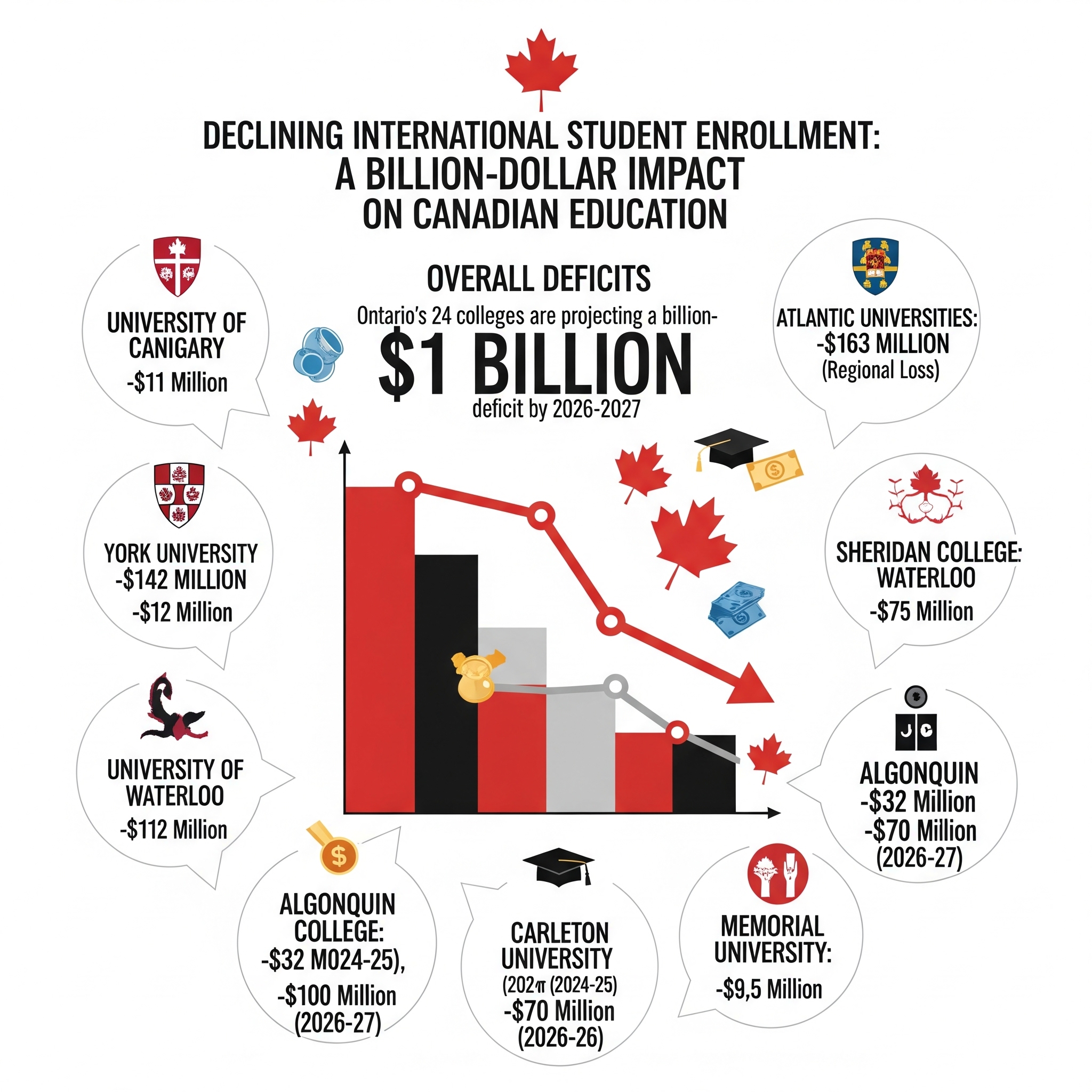
Overall Deficits: Ontario’s 24 colleges expect a staggering billion-dollar deficit by the 2026-2027 school year.
Specific Institution Examples:
– The University of Calgary reported an $11 million loss.
– Atlantic universities are projected to face a regional revenue and spending loss of $163 million due to an 11.4% decline in overall international enrolment.
– York University faces the largest projected deficit at $142 million.
– Sheridan College anticipates a $112 million revenue loss.
– The University of Waterloo estimates a $75 million deficit.
– Algonquin College expects a $32 million deficit for 2024-25, likely rising to nearly $100 million by 2026-27.
– Carlton University anticipates a $38 million deficit for the 2024-25 fiscal year, expected to increase to $70 million by 2025-26.
– Memorial University reported a $9.5 million loss.
Impact on International Students and Canada’s Reputation
Beyond the financial and employment impacts, these policy changes have serious implications for international students themselves and for Canada’s reputation as a study destination:
• Increased Competition and Uncertainty: Obtaining a study permit has become more competitive, especially for popular programs. The changes to post-graduation work permit eligibility also create uncertainty for students seeking work experience and the chance to transition to permanent residency in Canada. Students in programs linked to curriculum licensing agreements will no longer qualify for a post-graduation work permit, affecting a key pathway.
• Shifting Perceptions: Canada’s status as a welcoming and reliable study destination has suffered. Surveys show a drop in interest among potential international students, with some choosing other countries like Germany for lower tuition and easier visa access.
• Economic Contribution at Risk: International students contributed an estimated $37.3 billion to Canada’s economy in 2022, supporting over 360,000 jobs. The current policies threaten to lose this major economic contribution and the skilled talent that many international graduates bring to Canada’s future workforce.
Adapting to the New Reality
Canadian educational institutions are dealing with these significant changes. Many are pushing for more provincial funding to lessen their dependence on international tuition fees. Provinces like British Columbia and Ontario have announced some financial aid, but institutions still face tough choices about program cuts, hiring freezes, and delayed infrastructure projects.
The federal government has also made some adjustments, like including master’s and doctoral students in the cap while reserving a portion of spots for them, and requiring provincial attestation letters for study permit applications.
Conclusion
The new rules and regulations have undoubtedly created a challenging environment for Canada’s higher education sector. As institutions cope with widespread job losses, program cuts, and significant financial deficits, the long-term effects on Canada’s economy, its reputation as an educational leader, and its ability to attract global talent remain major concerns. The coming years will show how the sector adjusts and whether a more balanced approach to international education can be found.
(Md Asiuzzaman is a professor of Career Development and an education consultant based in Toronto, Canada. Multiple AI tools are used in research, analysis and writing this blog.)