


EduFirst Academy Offers Come to Canada Job-Ready: Your Three-Path Career Plan with AI
Md Asiuzzaman
Four Weeks. Four Years Ahead.
That is not a marketing slogan. It is a finding.
IRCC research tracking newcomer labour market outcomes during the first four years in Canada confirms what employment counsellors across the country already know: most internationally trained professionals spend years working toward employment that matches their qualifications. Not because they are underqualified, but because they were never taught how the Canadian job market works. And in today’s AI-era hiring landscape, the rules have changed faster than most job seekers realize.
Come to Canada Job-Ready: Your Three-Path Career Plan with AI was built to close that gap.
The Problem Is Structural, Not Personal
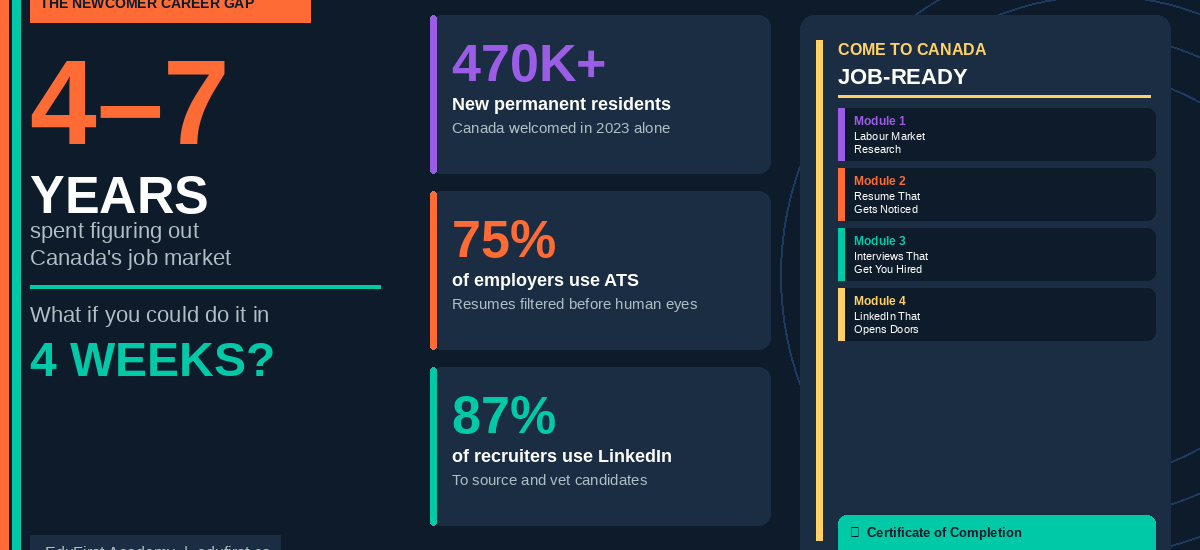
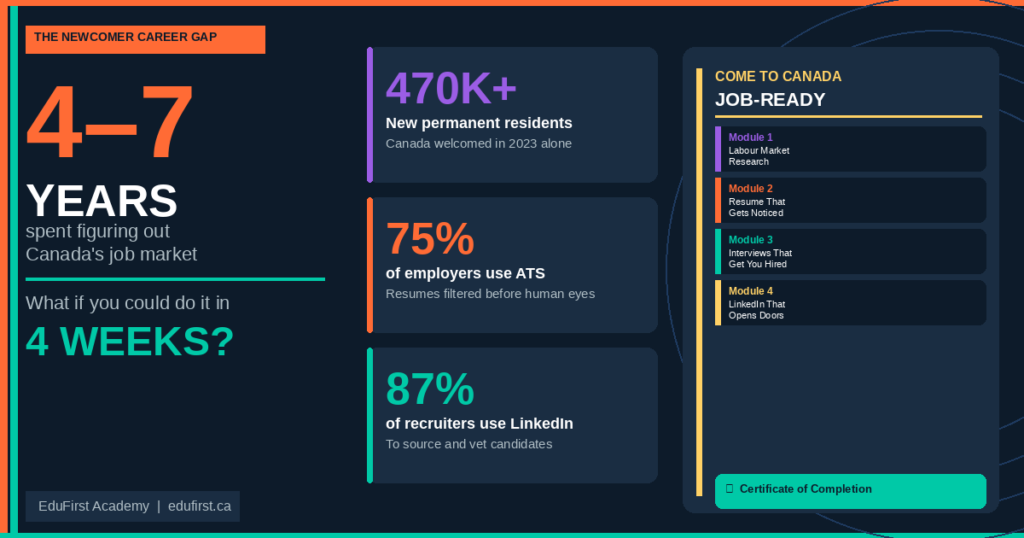
Canada welcomed over 470,000 new permanent residents in 2023, setting a record. Yet according to Statistics Canada, immigrants, especially recent arrivals, continue to face significantly higher unemployment and underemployment rates than Canadian-born workers, even when they hold equivalent credentials.
The barriers are well-documented in academic research (Picot & Sweetman, 2012; Oreopoulos, 2011): credential recognition gaps, unfamiliarity with Canadian hiring norms, ATS systems that filter out non-Canadian resume formats, and a professional network that simply does not yet exist upon arrival.
Add to that the seismic shift brought by artificial intelligence. Over 75% of large employers now use Applicant Tracking Systems to screen resumes before a recruiter ever sees them. AI-powered sourcing tools scan and rank LinkedIn profiles daily. Some organizations now use AI-driven video interviews that assess tone, word choice, and body language before a human enters the process.
For newcomers navigating an already unfamiliar job market, this is not just a challenge; it is a compounding disadvantage. And it is one that this course was specifically designed to address.
How the Course Was Developed and Why It Is Different
Come to Canada Job-Ready was not assembled from generic career advice. It was built from the ground up for the specific realities internationally trained professionals face in Canada’s AI-era hiring environment.
The course is competency-based, structured across four sequential modules, and anchored by what EduFirst calls the Three-Path Career Strategy, a framework that asks every learner to identify three realistic target roles in the Canadian labour market from the very first week, then build every subsequent deliverable — resume, interview preparation, LinkedIn profile — around those three real job postings. Nothing is hypothetical. Everything is applied.
Learners complete approximately 20–24 hours of structured learning, finish with a portfolio of career documents, and earn the EduFirst Academy Certificate of Completion upon achieving the passing threshold.
The Four Modules: What Learners Actually Do
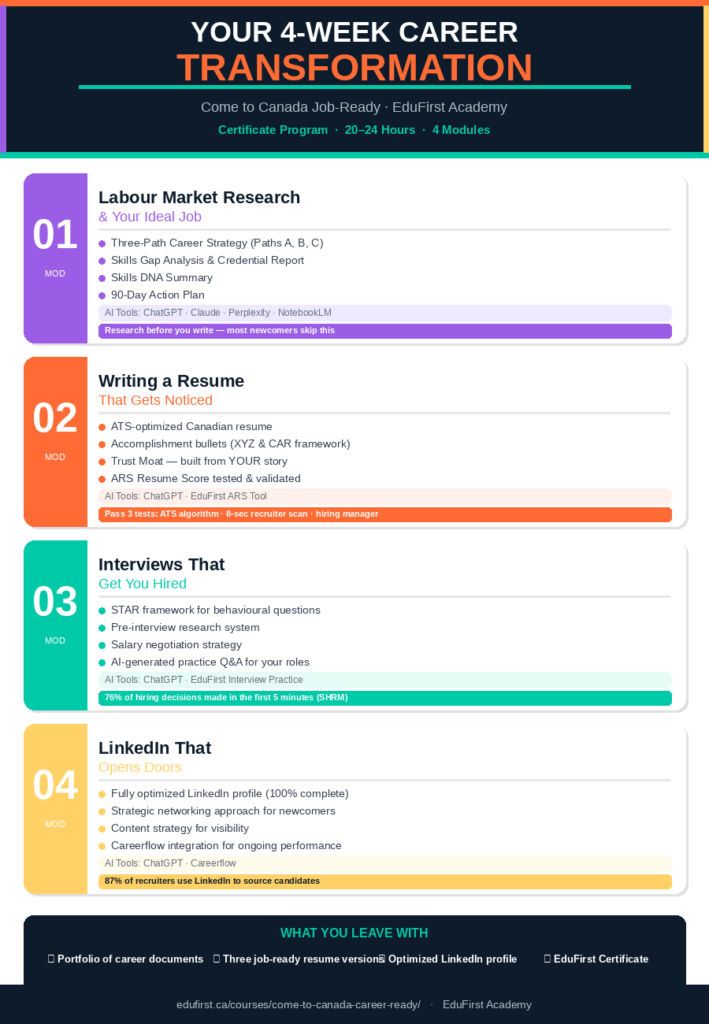
Module 1 — Labour Market Research & Your Ideal Job
Before writing a single resume bullet, learners do what most newcomers skip entirely: they systematically research the Canadian labour market. Module 1 covers regulated vs. non-regulated professions, the Skilled Trades and Red Seal pathways, the NOC classification system, credential recognition through WES, and how to use AI tools — ChatGPT, Claude, Gemini, Perplexity AI, NotebookLM for targeted labour market research.
The module’s signature deliverable is the Three-Path Career Strategy: three specific target job postings (Path A, B, and C) selected after a full skills gap analysis, a Credential Pathway Report, and a Skills DNA Summary. Learners also build a 90-Day Action Plan — a concrete roadmap from enrollment to first interview. This strategy becomes the anchor for everything that follows in Modules 2, 3, and 4.
Module 2 — Writing a Resume That Gets Noticed: Building Your Trust Moat with AI
Module 2 opens with a deliberate experiment: learners ask an AI to generate their resume and then discover precisely why generic AI output fails. That lesson sets the foundation for the module’s central concept: the Trust Moat, a personalized, accomplishment-based resume that no AI can replicate, because it is built from the learner’s own story, verified credentials, and real professional outcomes.
The module covers all eleven sections of a Canadian resume in the correct sequence, accomplishment-based bullet writing using the XYZ and CAR frameworks, ATS keyword optimization, and ethical use of AI as a drafting assistant rather than a final author. Learners use EduFirst’s own ARS Resume Score tool to test their resume against ATS criteria before submission.
The module’s core challenge: your resume must simultaneously pass three tests — an ATS algorithm, a recruiter who spends fewer than eight seconds on an initial scan, and a hiring manager reading carefully to decide whether you are worth interviewing. One failure ends your candidacy. Module 2 teaches learners to pass all three.
Module 3 — Interviews That Get You Hired: AI-Powered Preparation and Practice
Research by the Society for Human Resource Management (SHRM, 2023) found that 76% of hiring decisions are influenced within the first five minutes of an interview. Module 3 gives learners a structured system to make every minute count.
The module covers the full Canadian interview process, from pre-interview research and the STAR framework for behavioural questions to closing the interview and navigating salary negotiation. Learners use AI tools to generate practice questions tailored to their target roles and use EduFirst’s Interview Practice tool for structured practice with immediate feedback.
A critical insight this module teaches is that an interview is not a test of qualifications. The resume already passed that test. An interview is a performance — an opportunity to demonstrate not only competence, but fit, trust, and the confidence to be worth a hiring manager’s investment.
Module 4 — LinkedIn That Opens Doors: Building Your Professional Brand and Network with AI
According to LinkedIn’s own research (LinkedIn, 2024), 87% of recruiters use the platform to source and vet candidates. Professionals with complete LinkedIn profiles are 40 times more likely to appear in recruiter searches than those with incomplete ones. For newcomers, LinkedIn is not optional — it is the primary channel through which Canadian employers find candidates they haven’t met yet.
Module 4 delivers a complete system: a fully optimized LinkedIn profile, a strategic networking approach designed specifically for newcomers, a content strategy that builds visibility, and integration with Careerflow, a tool that maintains profile performance at 100% long after the course ends.
This module addresses what many newcomers find most unfamiliar: asking for professional connections, building relationships before needing them, and being visible to an industry before applying to it.
Why the AI Era Makes This Course More Urgent
AI has not made the job market easier for newcomers. It has made it more opaque.
Resumes are filtered before a human reads them. Profiles are ranked before a recruiter reaches out. Interviews are sometimes assessed before a manager is involved. For job seekers who don’t understand these systems, effort alone is not enough — candidates can apply to hundreds of positions and hear nothing, not because they are unqualified, but because they were invisible to the algorithm.
Come to Canada Job-Ready teaches learners to navigate both sides of this shift. AI is integrated throughout the course, not as a shortcut, but as a research tool, a drafting assistant, and a preparation partner. Learners leave knowing how to use it effectively and understanding exactly where human authenticity must take over.
Who This Course Is For
For newcomers and internationally trained professionals: Whether you have just arrived or have been struggling to break into qualified employment for months, this course gives you the structured system that most immigrants never had access to. You do not have to spend years figuring out what four weeks can teach you.
For settlement agencies and employment service providers: This course is a resource you can put directly in the hands of your clients — before and after arrival in Canada. It is self-paced, competency-based, and built on the same employment frameworks that employment counsellors use every day, now packaged as a complete online, certificate-bearing program. Partnering with EduFirst means your clients receive structured, consistent career preparation even when your caseload does not allow for intensive one-on-one support.
A Final Word
Most newcomers spend 4–7 years discovering what this course teaches in four weeks.
That number is not meant to discourage. It is meant to clarify what is at stake — and what is possible. The Canadian job market is not impossible to navigate. It is simply unfamiliar. And unfamiliarity, unlike a credential gap, can be closed quickly with the right map.
Four Weeks. Four Years Ahead.
Canada is hiring — and you can be ready for it. For course details, visit edufirst.ca.
AI Use Disclosure
This blog post was researched and drafted with the assistance of multiple AI tools. The author reviewed, verified, and edited all content, including the synthesis of source materials, in-text citations, and conclusions. All referenced documents were provided by the author and interpreted with professional judgment. AI-assisted drafting was used to support efficiency and clarity, not to replace original idea, critical analysis or subject-matter expertise.
References
Dattner, B., Chamorro-Premuzic, T., Buchband, R., & Schettler, L. (2019, November). The legal and ethical implications of using AI in hiring. Harvard Business Review. https://hbr.org/2019/11/how-companies-are-using-ai-to-assess-job-candidates
Government of Canada. (2024, January). Canada welcomes record number of newcomers in 2023. Immigration, Refugees and Citizenship Canada. https://www.canada.ca/en/immigration-refugees-citizenship/news/2024/01/canada-welcomes-record-number-of-newcomers-in-2023.html
Immigration, Refugees and Citizenship Canada. (n.d.). Newcomer labour market outcomes: Tracking internationally trained professionals in Canada. Government of Canada. [Add specific URL]
Jobscan. (n.d.). Fortune 500 companies that use applicant tracking systems. Jobscan Blog. https://www.jobscan.co/blog/99-percent-fortune-500-ats/
LinkedIn. (2024). LinkedIn recruiter and job seeker data. LinkedIn. https://www.linkedin.com/pulse/new-survey-reveals-85-all-jobs-filled-via-networking-lou-adler
Oreopoulos, P. (2011). Why do skilled immigrants struggle in the labor market? A field experiment with thirteen thousand resumes. American Economic Journal: Economic Policy, 3(4), 148–171.
Picot, G., & Sweetman, A. (2012). Making it in Canada: Immigration outcomes and policies. Institute for Research on Public Policy.
Society for Human Resource Management. (2023). Interviewing and hiring practices. SHRM.
Statistics Canada. (2023). Immigrant labour force characteristics. Statistics Canada. https://www150.statcan.gc.ca/n1/pub/71-606-x/2008004/t/4193095-eng.htm