


An inside look at the course that puts you in the Director’s Chair — using AI as a tool, not a crutch, to land the job that is right for you.
Md Asiuzzaman
There is a paradox sitting at the heart of today’s job market: the same companies deploying AI to screen thousands of applications are ultimately looking for something no algorithm can replicate — the Trust Moat of a human being whose voice, judgment, and story come through unmistakably. Get Job-Ready in Six Weeks: Career Preparation with AI, developed by EduFirst Academy, is designed to resolve that paradox.
The Problem This Course Was Built to Solve
Consider a single data point: over 11,000 job applications are submitted every minute on LinkedIn alone (The New York Times, 2024). In that environment, the instinct to use AI to apply faster makes sense — until you realize that every other applicant has the same instinct. When AI generates your resume, your cover letter, and your outreach messages, the result is not a competitive edge; it is camouflage. You disappear into a sea of identically polished but personality-free documents, and a recruiter who spends an average of 7.4 seconds on an initial resume scan (TheLadders, 2018) will never see what makes you worth hiring.
EduFirst Academy developed this course specifically for new graduates, career changers, newcomers to Canada, and working professionals. The founding insight was straightforward: the problem was never that job seekers were ignoring AI. The problem was that they were over-relying on it — and unknowingly stripping out the very thing that gets people hired.
| “Stop being a Doer — someone who completes tasks manually — and start thinking like a Director. You sit in the Director’s Chair: assign the right tasks to AI, judge the output critically, and invest your human energy where it matters most.” |
This “Director’s Chair” mindset is the philosophical backbone of the entire course. It is not an AI course. It is a career course — one that puts AI to work for the learner.

Course Design: Built Backward from Real Outcomes
The course’s instructional architecture draws on Backward Design (Wiggins & McTighe, 2005), beginning with the end in mind: what does a job-ready candidate actually look like, and what must they be able to do? From that destination, every module, activity, and assessment was designed to produce a tangible career deliverable — not a reflection paper or a quiz, but a real document a learner can submit the moment they complete the assignment.
The framework also integrates Kolb’s Experiential Learning Cycle (Kolb, 1984), Competency-Based Education (Voorhees, 2001), and Social Cognitive Career Theory (Lent et al., 1994), which together ensure that each week builds self-efficacy alongside practical skills. By the time learners reach Module 6, they have not just learned about the job market — they have done the actual work of navigating it.
The course is offered in three delivery formats: fully self-paced online through the EduFirst LMS, asynchronous guided (for institutions and groups), and synchronous live via Zoom or Teams — all covering the same curriculum and awarding the same Certificate of Completion.
Six Modules, Six Deliverables: The Curriculum in Details
Each of the six modules corresponds to one week of focused work (approximately 5–6 hours) and produces one professional career deliverable. Together, they form a complete career preparation system.
WEEK 1 · Labour Market Research in the Age of AI
Learners begin where every job search must: with a clear, evidence-based picture of the market. This module covers how AI is restructuring Canada’s labour market across three waves of disruption, how to use tools like Job Bank, the ICTC Digital Talent Outlook, and the Labour Market Information Council’s dashboard to research demand and salary, and how to build a Skills DNA map — the granular, transferable abilities that remain valuable even when a job title disappears. The deliverable is a comprehensive AI-Informed Labour Market Analysis and Career Strategy, including a three-scenario career plan targeting at least three viable job titles.
WEEK 2 · Finding the Ideal Job
The visible job market — everything posted publicly on job boards — accounts for only 20–30% of actual hires (Granovetter, 1995; LinkedIn, 2024). The remaining 50–65% are filled through referrals, direct outreach, and the hidden job market. This module teaches learners to build a personal platform stack across Canadian-specific job boards, use Boolean and AI-assisted search, access the hidden market through proactive employer outreach, and manage their search as a structured project using tools like Teal HQ. The deliverable is a full Personalized Job Search Strategy Package, including a hidden-market outreach plan with 10 real target organizations.
WEEK 3 · Writing a Resume That Gets Noticed
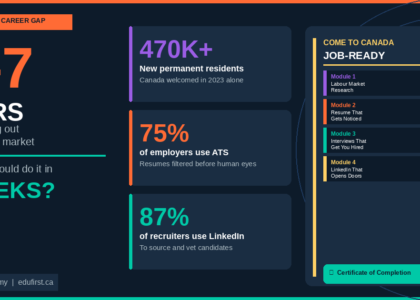
Over 98% of Fortune 500 companies and a rapidly growing share of Canadian employers use Applicant Tracking Systems (ATS) to filter resumes before any human reads them (Jobscan, 2024). A generic resume achieves only a 2.68% conversion rate from application to interview — but customized resumes achieve 5.75%, a 115% improvement (Huntr, 2025). This module builds a complete, ATS-optimized Canadian-style resume section by section across seven guided activities, using the CAR and XYZ frameworks for accomplishment-based bullets, and AI tools, including Jobscan for keyword scoring. The deliverable IS the resume — submission-ready by the module’s end.
WEEK 4 · The Interview Edge: Preparation and Practice
Research shows that 76% of hiring decisions are made within the first five minutes of an interview (SHRM, 2023) — not because hiring managers are inattentive, but because preparation and presence are immediately visible. This module covers the anatomy of modern interview formats, the four dimensions hiring managers evaluate, the STAR framework for behavioural answers, and AI-powered preparation tools, including Google Interview Warmup and Big Interview. Learners also build a salary negotiation strategy grounded in data from Job Bank, Glassdoor, and Payscale. The deliverable is a complete Interview Preparation Package, including a 10-question STAR story bank and documented AI mock practice evidence.
WEEK 5 · Job Retention: Thriving from Day One
Most career preparation courses end with the offer letter. This one does not. Research by Watkins (2013) established that the habits, relationships, and professional reputation built in the first 90 days of a new role have a disproportionate impact on long-term career trajectory. This module teaches learners to design a structured 90-day onboarding plan, use AI tools to accelerate productivity — McKinsey research shows AI-integrated workers are 20–40% more productive on knowledge tasks (McKinsey, 2023) — manage up effectively, and navigate Canadian workplace culture, including multiculturalism. The deliverable is a 90-Day Success Plan and Career Growth Strategy.
WEEK 6 · Your Always-On Career Engine: LinkedIn and Networking with AI
87% of recruiters use LinkedIn to source and vet candidates, and fully complete profiles receive 40 times more job opportunities than incomplete ones (LinkedIn, 2024). This final module teaches learners how LinkedIn’s search algorithm works, how to optimize every profile section for both algorithmic and human audiences, and how to build a networking strategy grounded in Granovetter’s weak-ties theory and LinkedIn’s finding that referred candidates are four times more likely to receive an offer. The deliverable is a fully optimized LinkedIn profile at All-Star status, plus a networking and content calendar designed for long-term career visibility.
The Numbers That Shaped the Course
Every instructional decision in this course was informed by research. The statistics below are not supplementary — they are the architectural foundations of the curriculum.
| 4× More likely to receive an offer as a referred candidate, LinkedIn, 2024 | 11,000 Applications submitted per minute on LinkedIn, The New York Times, 2024 | 40× More recruiter views for All-Star LinkedIn profiles, LinkedIn, 2024 | 5.75% Conversion rate for customized resumes (115% improvement) Huntr, 2025 |
| 7.4 sec Average recruiter time on initial resume review TheLadders, 2018 | 250+ Average applications received per corporate job posting, LinkedIn, 2024 | 2.68% Interview conversion rate for generic, untailored resumes, Huntr, 2025 | 40× More recruiter views for All-Star LinkedIn profiles LinkedIn, 2024 |
What Learners Walk Away With
Each module ends with a graded assignment that produces a professional-quality deliverable for the career. By the end of the course, learners have assembled a complete toolkit they can use immediately.
- Each module ends with a graded assignment that produces a professional-quality deliverable for the career. By the end of the course, learners have assembled a complete toolkit they can use immediately.
- A Labour Market Research Report identifying best-fit opportunities in the Canadian job market
- A Personalized Job Search Strategy Package covering visible and hidden markets
- A submission-ready, ATS-optimized resume achieving 70%+ keyword match score (Jobscan, 2024)
- A Complete Interview Preparation Package with STAR stories, AI mock practice evidence, and a salary negotiation strategy
- A 90-Day Onboarding and Career Growth Plan grounded in Watkins’ (2013) transition research
- A fully optimized LinkedIn profile at All-Star status, with a networking and content calendar
- 42 ready-to-use AI prompts for every stage of the job search
- Two ATS-friendly, fillable resume templates in Word format
- Access to two EduFirst-developed apps: Career Pathway Finder and Resume Score
AI Fluency as a By-Product, Not the Goal
This is not an AI course — and EduFirst Academy was deliberate about that. The goal is not to produce prompt engineers. The goal is to produce job-ready candidates. However, as learners work through six modules on research, writing, and strategy, they naturally develop practical AI fluency across a meaningful set of tools.
Over the course of six weeks, learners work with ChatGPT, Claude, Microsoft Copilot, and Google Gemini for research and writing tasks; Jobscan and Resume Worded for ATS scoring; Google Interview Warmup and Big Interview for mock interview practice; Teal HQ and Huntr for job search tracking; Perplexity AI and Consensus for evidence-based research; and LinkedIn’s AI-powered job matching and profile analytics. Each tool is introduced in the context in which it genuinely adds value — not as a demonstration, but as a working component of the learner’s career-preparation process.
The course is equally explicit about the limits of AI. The signature Activity 1B in Module 3 — the “AI Resume Mirror” — asks learners to generate an AI resume for their target job, then methodically identify everything in it that they cannot truthfully claim. The exercise is not about catching AI making mistakes. It is about developing the discernment to distinguish between a document that appears to be a strong candidate and one that actually represents one. That discernment — what the course calls the Trust Moat — is the irreplaceable human layer that determines whether a candidate gets hired.
How This Course Differs from Conventional Career Preparation
| Dimension | Conventional career prep | Get Job-Ready in Six Weeks |
| Output | Academic essays and reflective exercises | Real career deliverables are usable the moment they are submitted |
| AI stance | Ignores AI or treats it as a shortcut to apply faster | Director’s Chair mindset — AI as a strategic tool, not a ghostwriter |
| Job market scope | Focuses almost entirely on public job boards | Covers visible, semi-hidden, and hidden markets with specific strategies for each |
| Resume approach | Generic tips on formatting and grammar | Section-by-section build with ATS scoring, CAR/XYZ frameworks, and AI-tailored workflow. |
| Canadian context | Generic content repurposed from U.S. sources | Built for the Canadian market — Job Bank, NOC, ICTC, provincial boards, Canadian conventions |
| Post-offer content | Ends at the job offer | Includes a full module on the first 90-day retention and career growth |
| Research base | General career advice drawn from broad sources | Every module is grounded in peer-reviewed research and includes APA in-text citations. |
Whom the Course Is Built For
EduFirst Academy designed this course with four learner profiles specifically in mind — and a curriculum flexible enough to serve all of them:
| Recent graduates who are entering a market far more competitive than anything their degree program prepared them for, and who need structured support in translating academic experience into professional credentials. Career changers who have transferable skills but lack a framework for communicating them across sectors. Newcomers to Canada who are navigating Canadian workplace norms, resume conventions, and credentialing requirements for the first time. Working professionals who are re-entering the market after a gap, seeking advancement, or proactively future-proofing their careers in an AI-transformed economy. |
The self-paced format, with no fixed start date and fully flexible scheduling, was a deliberate choice for this audience. Career transitions do not follow academic calendars, and the learners EduFirst Academy serves are often balancing job searching with existing professional or family commitments.
| Six weeks. Six deliverables. One decisive advantage in the AI-era job market. |
References
- Granovetter, M. (1995). Getting a job: A study of contacts and careers (2nd ed.). University of Chicago Press.
- Huntr. (2025). Job search conversion benchmarks 2025. Huntr Inc. https://huntr.co
- Information and Communications Technology Council. (2024). Digital talent outlook. https://www.digitalthinktankictc.com
- Jobscan. (2024). Job seeker nation: The state of the job market in 2024. Jobscan Inc. https://www.jobscan.co/job-seeker-nation
- Kolb, D. A. (1984). Experiential learning: Experience as the source of learning and development. Prentice Hall.
- Lent, R. W., Brown, S. D., & Hackett, G. (1994). Toward a unifying social cognitive theory of career and academic interest, choice, and performance. Journal of Vocational Behavior, 45(1), 79–122. https://doi.org/10.1006/jvbe.1994.1027
- LinkedIn. (2024). Global talent trends 2024: The reinvention of work. LinkedIn Corporation. https://business.linkedin.com/talent-solutions/global-talent-trends
- McKinsey Global Institute. (2023). The economic potential of generative AI: The next productivity frontier. McKinsey & Company. https://www.mckinsey.com/capabilities/mckinsey-digital/our-insights/the-economic-potential-of-generative-ai-the-next-productivity-frontier
- Mitchell, K. E., Levin, A. S., & Krumboltz, J. D. (1999). Planned happenstance: Constructing unexpected career opportunities. Journal of Counseling & Development, 77(2), 115–124. https://doi.org/10.1002/j.1556-6676.1999.tb02431.x
- Society for Human Resource Management. (2023). Talent acquisition: The state of hiring in 2023. https://www.shrm.org/resourcesandtools/hr-topics/talent-acquisition
- The New York Times. (2024, February 26). The miserable experience of job hunting in the age of AI. https://www.nytimes.com
- TheLadders. (2018). Keeping an eye on recruiter behavior. https://cdn.theladders.net/static/images/basicSite/pdfs/TheLadders-EyeTracking-StudyC2.pdf
- Voorhees, R. A. (2001). Competency-based learning models: A necessary future. New Directions for Institutional Research, 2001(110), 5–13. https://doi.org/10.1002/ir.1
- Watkins, M. D. (2013). The first 90 days: Proven strategies for getting up to speed faster and smarter. Harvard Business Review Press.
- Wiggins, G., & McTighe, J. (2005). Understanding by design (2nd ed.). ASCD.
- World Economic Forum. (2023). The future of jobs report 2023. https://www.weforum.org/reports/the-future-of-jobs-report-2023
AI Use Disclosure
This blog post was researched and drafted with the assistance of multiple AI tools. The author reviewed, verified, and edited all content, including the synthesis of source materials, in-text citations, and conclusions. All referenced documents were provided by the author and interpreted with professional judgment. AI-assisted drafting was used to support efficiency and clarity, not to replace critical analysis or subject-matter expertise.