

How agentic AI is reshaping the workplace — and what it means for you
Md Asiuzzaman
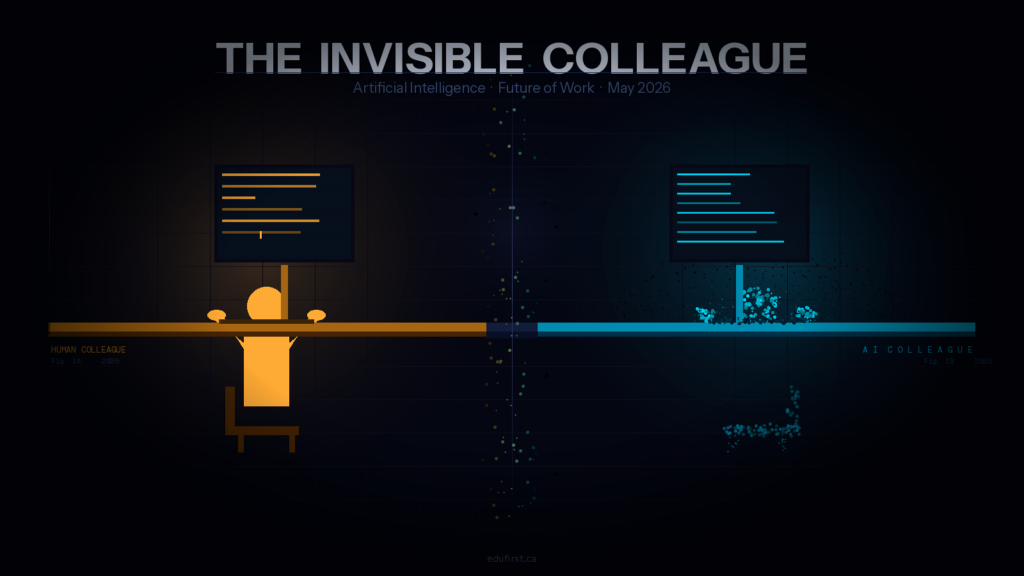
Imagine showing up to your first day at a new job. You meet your manager, your team, and a colleague who never takes a break, never calls in sick, and can draft a report in seconds. You cannot see them, shake their hand, or grab coffee with them — but they are already sitting at the next desk, embedded in every workflow. That invisible colleague is agentic artificial intelligence, and the workplace is about to change forever.
The transition is not coming; it is already here. This month (May 2026), OpenAI finalized The Deployment Company — a $10 billion joint venture designed to embed AI directly into the operations of thousands of businesses across healthcare, finance, and manufacturing (Bloomberg, 2026). Within minutes, Anthropic announced a parallel venture backed by Goldman Sachs, Blackstone, and Sequoia Capital. These are not pilots. They are industrial-scale deployments happening now.
According to the World Economic Forum’s Future of Jobs Report 2025, 170 million new roles will be created and 92 million displaced by 2030, for a net gain of 78 million jobs (World Economic Forum [WEF], 2025). Technology is the single most disruptive force driving this change. The question is no longer whether AI will affect your career; it is whether you will affect AI. It is whether you are ready to direct it.
“The time is now for businesses and governments to work together, invest in skills and build an equitable and resilient global workforce.” — Till Leopold, World Economic Forum (WEF, 2025)
From Doer to Director: A New Role for Every Worker
For decades, career advice has been straightforward: develop a skill, apply it, and get paid. AI changes that formula. Think of it as the Director’s Chair analogy: the best employees of tomorrow will not be the ones who do the most tasks. They will be the ones who direct the best AI to do them efficiently.
The “doers” in this new equation are AI agents. They execute, iterate, draft, analyze, and automate. Your job is to brief them, verify their output, redirect them when they go wrong, and take responsibility for the results. That is leadership — applied to a machine.
The Anthropic Economic Index, which analyses millions of real conversations with Claude, found that 49% of jobs now use AI for at least a quarter of their tasks — up from 36% in January 2025 alone (Anthropic, 2025). This is not a slow-burn trend. It is a fast-moving shift in how work gets done.
The implication is stark. Most employees will soon have access to powerful AI tools. Access is not enough. The workers who will thrive are those who know how to use them well.
The Skills Gap Is Growing — and Graduates Are Feeling It
Here is an uncomfortable truth. Many job seekers today are using AI like a search engine. They type a question. They copied the answer. They submit the work. That approach will not cut it in the modern workplace, and employers know it.
Data from Huntr’s Q1 2025 Job Search Trends Report — which analyzed 636,000 job postings — found that over 99% of AI-related skills are listed as required, not preferred or nice-to-have (Huntr, 2025a). AI integration nearly doubled its share of job postings in a single quarter. Employers are not experimenting. They are required.
The mismatch with graduate readiness is alarming. Research cited in The Interview Guys’ State of Job Search 2025 found:
- 33% of 2025 graduates and 20% of 2024 graduates are unemployed and actively seeking work.
- 48% of recent graduates feel unprepared for entry-level positions.
- 56% of those who feel unprepared cite job-specific skills as their biggest gap (The Interview Guys, 2025).
Half of educators dedicate 20% or less of the curriculum to workforce skills. That gap between what universities teach and what employers need has never been wider.
The WEF Future of Jobs Report 2025 reinforces this: 39% of core worker skills are expected to change by 2030. Analytical thinking is now the number one skill employers want, cited by 7 in 10 companies (WEF, 2025). Resilience, curiosity, and lifelong learning follow closely.
“AI and big data top the list of the fastest-growing skills. But creative thinking and analytical reasoning are rising just as fast.” — WEF Future of Jobs Report 2025
AI Hallucinations Are Real — and They Could Cost You Your Job
Here is something no one tells you in a generic AI tutorial: AI makes things up. It is called a hallucination, and it happens when an AI model generates plausible-sounding but factually incorrect information. It can invent citations, fabricate statistics, and produce confident-sounding errors.
If you accept AI output at face value, you become responsible for those errors. In a professional context, that could mean submitting a report with false data, advising a client based on wrong information, or making a business decision on a flawed analysis.
The Anthropic Economic Index now measures task success rates as a core metric precisely because AI does not always get it right (Anthropic, 2026a). This is why domain knowledge matters more than ever. You cannot spot an error you do not understand. A professional who knows their field can catch what the AI gets wrong. One who delegates and submits cannot.
This is the new literacy. Not just knowing how to prompt an AI, but knowing enough to evaluate what it gives back.
What Employers Are Looking for in the AI Era
Employers are responding to this landscape with urgency. The WEF reports that 77% of employers plan to prioritize reskilling and upskilling by 2030, with a focus on AI collaboration (WEF, 2025). At the same time, 73% plan to accelerate process and task automation.
Skills-based hiring is accelerating. Degrees are losing ground to demonstrated competencies. Python tops technical job postings at 36.7%, followed by SQL at 26.6%, according to Huntr’s Q1 2025 data (Huntr, 2025a). However, technical skills alone are not enough.
The Huntr 2025 Annual Job Search Trends Report found that the strongest competitive advantage now sits at the intersection of leadership, AI fluency, and operational depth (Huntr, 2025b). AI fluency means knowing what the tool can and cannot do. Operational depth means understanding the domain well enough to direct the AI with precision. Leadership means owning the outcome regardless of who — or what — did the work.
Employers are already testing for this. During job interviews and screening processes, technical skills assessments are becoming standard. Can you use AI to solve a real problem — accurately and efficiently? That is the test.
The Two Classes of Worker: Which Side Are You On?
Analysis of Anthropic’s Economic Index data reveals a stark split: the tech workforce is splintering into two groups—those skilled in AI and those not (Built In, 2026).
Experienced AI users know how to enhance their work with AI tools. They iterate, verify, and combine AI output with their own expertise. They are augmenting their intelligence. The result is not just productivity — it is a salary premium. Machine learning professionals earned 50.3% above the average salary in Q3 2025, with AI specialists close behind at 44.7% above average (Huntr, 2025c).
Workers who cannot adapt face a different reality. As Anthropic’s research shows, companies experimenting with AI agents are already trimming headcounts, retaining small teams who manage networks of AI agents rather than large teams doing the tasks themselves (Built In, 2026).
This is not a distant future. The Anthropic Economic Index Survey, which draws on 81,000 open-ended survey responses from Claude users, found that one in five respondents voiced concern about economic displacement — and those experiencing the largest productivity gains from AI are also the most worried about their long-term job security (Anthropic, 2026b).
“If the time required to do your tasks is shrinking quickly, there may be more uncertainty about the future viability of your role.” — Anthropic Economic Index Survey, 2026
The Invisible Colleague Goes Corporate: AI’s Biggest Power Move
If you needed proof that the invisible colleague is real, look no further than May 2026. In a single week, the two leading AI companies announced billion-dollar ventures designed to embed AI into the core operations of businesses worldwide.
OpenAI finalized The Deployment Company — a $10 billion joint venture backed by 19 investors, including TPG, Brookfield Asset Management, Bain Capital, and SoftBank. The venture’s mandate is not simply to sell AI software. It will embed OpenAI engineers directly inside client companies — rebuilding workflows from the inside out (Bloomberg, 2026). Target sectors include healthcare, finance, manufacturing, and logistics. The partners have access to more than 2,000 portfolio companies. The invisible colleague is being deployed at scale.
Within minutes of that announcement, Anthropic revealed a parallel venture of its own, backed by Blackstone, Goldman Sachs, Hellman & Friedman, Apollo Global Management, and Sequoia Capital. Anthropic’s aim: to deploy its Claude AI system into the core operations of midsize companies worldwide (Bloomberg, 2026).
This is the moment agentic AI shifts from a boardroom conversation to a ground-floor reality. These are not pilots or proof-of-concept projects. They are industrial-scale deployments backed by the world’s most powerful financial institutions.
“Both efforts coincide with the rise of forward-deployed engineers — people embedded inside client firms to rebuild workflows around AI.” — Bloomberg, May 2026
The model these ventures are adopting is called forward-deployed engineering. Pioneered by Palantir, it means AI specialists sit alongside client teams, not in a vendor’s office. They observe, redesign, and automate. The invisible colleague is no longer invisible to the organization — it is woven into every system, every process, every decision layer.
For workers and graduates, the message is urgent. When AI companies invest billions to place their technology inside the companies you want to work for, AI fluency stops being a competitive advantage. It becomes the entry requirement. The question is not whether AI will be in your workplace. It is whether you will know how to work alongside it when it arrives.
How to Prepare: Taking Your Place in the Director’s Chair
The good news: this is a skills challenge, not a displacement sentence. Here is where to start.
- Build domain depth first. AI cannot replace expertise it lacks. The more you know about your field, the better you can direct and verify AI output.
- Learn to prompt with precision. Vague prompts produce vague results. Specific, structured instructions — with context, constraints, and examples — produce professional-grade output.
- Develop critical evaluation skills. Every AI output is a first draft, not a final answer. Fact-check, cross-reference, and apply professional judgement before anything goes out the door.
- Embrace continuous learning. Deloitte estimates the shelf life of technical skills is under three years. Staying current is not optional — it is career maintenance (Huntr, 2025a).
- Prepare for AI-assisted assessments. Employers are increasingly administering technical skills tests. Practice using AI tools in realistic conditions—not just casually.
Your Invisible Colleague Is Already at the Office
The future workplace will not ask whether you are comfortable with AI. It will assume you are. The question it will ask — in every interview, every project, every decision — is whether you know how to be the Director.
Your invisible colleague will work faster than you, forget nothing, and never need a coffee break. However, it will also hallucinate facts, miss context, and make confident mistakes. Your value is in knowing the difference.
Subject-matter knowledge, critical thinking, and problem-solving are not soft skills in this environment. They are the hard edge that makes AI useful rather than dangerous. Workers who combine those qualities with AI fluency will not just survive the coming transformation; they will thrive. They will lead it.
The Director’s Chair is vacant. Are you ready to sit in it?
AI Use Disclosure
This blog post was researched and drafted with the assistance of multiple AI tools. The author reviewed, verified, and edited all content, including the synthesis of source materials, in-text citations, and conclusions. All referenced documents were provided by the author and interpreted with professional judgment. AI-assisted drafting was used to support efficiency and clarity, not to replace original idea, critical analysis or subject-matter expertise.
References
Anthropic. (2025). Introducing the Anthropic Economic Index. https://www.anthropic.com/news/the-anthropic-economic-index
Anthropic. (2026a). New building blocks for understanding AI use: Economic primitives. https://www.anthropic.com/research/economic-index-primitives
Anthropic. (2026b). What 81,000 people told us about the economics of AI. https://www.anthropic.com/research/81k-economics
Anthropic. (2026c). Announcing the Anthropic Economic Index Survey. https://www.anthropic.com/research/economic-index-survey-announcement
Bloomberg. (2026, May 4). OpenAI finalizes $10 billion joint venture with PE firms to deploy AI. https://finance.yahoo.com/sectors/technology/articles/openai-finalizes-10-billion-joint-123100557.html
Built In. (2026, March 5). Anthropic’s Economic Index shows the AI skills gap is growing. https://builtin.com/articles/anthropic-economic-index-2026-ai-jobs-report
Huntr. (2025a). Job search trends report Q1 2025. https://huntr.co/research/job-search-trends-q1-2025
Huntr. (2025b). 2025 annual job search trends report. https://huntr.co/research/2025-annual-job-search-trends-report
Huntr. (2025c). Job search trends report Q3 2025. https://huntr.co/research/job-search-trends-q3-2025
The Interview Guys. (2025). State of job search 2025: Comprehensive research report. https://blog.theinterviewguys.com/state-of-job-search-2025-research-report/
World Economic Forum. (2025). The future of jobs report 2025. https://www.weforum.org/publications/the-future-of-jobs-report-2025/