


Md Asiuzzaman
In my previous post, I examined Canada’s credential inflation crisis: a paradox where the country leads the G7 with approximately 64% of working-age adults holding college or university credentials (Statistics Canada, 2026), yet record numbers of graduates remain overqualified for their positions. The response was significant. After more than 1,900 LinkedIn impressions, one question persisted: What is the solution?
Drawing on my experience in career education, I propose a focus on ‘tight skills.’ In hockey, a tight turn is a precise maneuver executed under pressure in limited space. Similarly, tight skills refer to competencies that are precisely aligned with occupational demand, contextually relevant to the Canadian workplace, and resilient amid AI-driven changes.
Credentials alone are insufficient. To understand why skills represent the true solution, it is necessary to address a foundational question: What constitutes a skill, and does this definition remain adequate?

Defining Skills: More Than “Knowing How”
The concept of a skill is deceptively simple. At its most basic, a skill is “the ability to do something well, usually gained through training or experience” (Cambridge Dictionary, 2024). However, that definition barely scratches the surface of what labour economists, cognitive scientists, and educators mean when they talk about skills.
A more rigorous framework distinguishes between three broad categories. Cognitive skills include reasoning, problem-solving, critical thinking, and the ability to learn from new information. Technical or practical skills refer to domain-specific competencies — operating machinery, writing code, reading a balance sheet, or conducting a clinical assessment. Socio-emotional skills, often called soft skills, include communication, adaptability, collaboration, emotional regulation, and self-direction (OECD, 2019).
The Organization for Economic Co-operation and Development’s Skills Outlook framework adds an important dimension: skills exist on a spectrum of transferability. Some skills are highly occupation-specific and depreciate quickly as technologies evolve. Others — particularly higher-order cognitive and interpersonal skills — remain durable across contexts and time horizons (OECD, 2019). This distinction will become critical when we talk about AI.
Is the Definition of Skills Changing?
The definition of skills is indeed evolving, and at a pace that exceeds the capacity of the current labour market infrastructure to adapt.
Throughout most of the 20th century, skills were viewed in binary terms: an individual either possessed a skill or did not. Credentials served as proxies for skills, with degrees indicating acquisition of specific knowledge and competencies. This logic is now failing in the Canadian context.
Currently, the concept of skill increasingly encompasses meta-skills, such as the capacity to learn, unlearn, and relearn. The World Economic Forum’s Future of Jobs Report 2023 indicates that 44% of workers’ core skills are expected to change within five years, with analytical, creative, and resilience skills now among the most sought-after competencies globally (WEF, 2023). These are not skills acquired once during a degree program; rather, they require ongoing development.
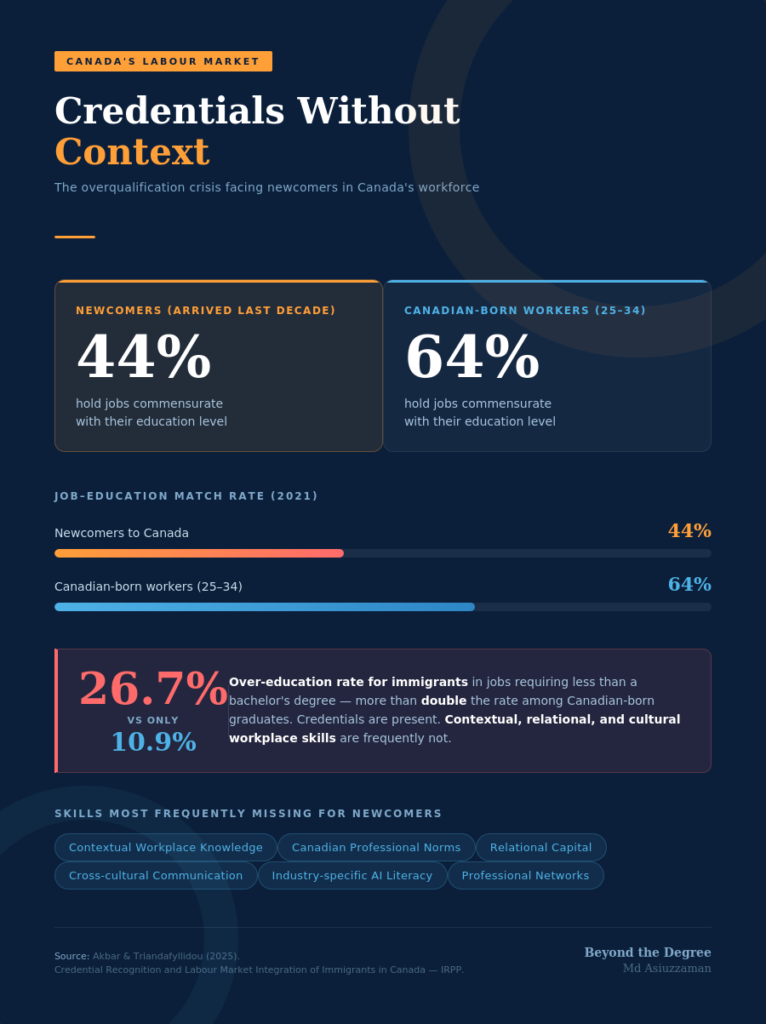
There is increasing recognition that contextual competence is as important as technical knowledge. For example, a civil engineer who understands Canadian building codes, workplace culture, and the dynamics of multi-stakeholder projects is significantly more job-ready than one with technical expertise alone. This issue is particularly acute for newcomers to Canada. The overqualification crisis among immigrants is notable: in 2021, only 44% of immigrants who arrived in the previous decade held jobs commensurate with their education levels, compared to 64% of Canadian-born workers aged 25–34 (Akbar & Triandafyllidou, 2025). The over-education rate for immigrants in jobs requiring less than a bachelor’s degree was 26.7%, more than double the 10.9% rate among Canadian-born graduates (Akbar & Triandafyllidou, 2025). While credentials are often present, the contextual, relational, and cultural skills necessary for success in the Canadian workplace are frequently lacking.
Skills in the Canadian NOC: A System Under Pressure
Canada’s National Occupational Classification (NOC) is the country’s primary framework for categorizing and describing the labour market. In its most recent iteration, the 2021 NOC introduced a restructured hierarchy that includes approximately 516 base-level occupational units — each defined by a specific bundle of tasks, duties, knowledge, and skill requirements (Statistics Canada, 2021).
The NOC functions as more than a bureaucratic taxonomy. It governs labour market information, immigration points systems, employment insurance, and the alignment of training programs. The way the NOC defines skills has significant implications for policy, hiring practices, and for workers navigating the system.
The current NOC framework categorizes occupations along two axes: Training, Education, Experience, and Responsibilities (TEER), a tiered system ranging from TEER 0 (management) to TEER 5 (short-term demonstration). Each of the 516 base occupational units includes an implicit skills profile. However, a key vulnerability exists: these skill profiles were largely developed prior to the widespread adoption of generative AI.
How AI Will Reshape Skills Across the 516 NOC Occupations
The forthcoming NOC 2026 — due for public release in December 2026 and featuring content updates to over 150 unit groups — represents a critical opportunity, though its current scope focuses primarily on health, education, and emergency services. The case must be made that AI’s impact on skills be explicitly embedded across all 516 base occupations: artificial intelligence is not a peripheral influence; it is actively restructuring the composition of workplace tasks.
Research from McKinsey Global Institute estimates that between 60 and 70% of tasks across occupations globally could be automated by currently available AI technologies — not all at once, but incrementally, task by task (McKinsey Global Institute, 2023). In Canada, the implications vary dramatically by TEER category.
For TEER 4 and 5 occupations, which typically require short-cycle training and involve routine data processing, document handling, or predictable manual tasks, AI is likely to reduce or eliminate substantial portions of existing tasks. Roles in administrative support, entry-level financial services, and basic data entry are already experiencing these changes. The next NOC revision must recognize that these positions may either disappear in their current form or shift toward AI oversight and quality assurance functions, necessitating new cognitive skills not currently included in their profiles.
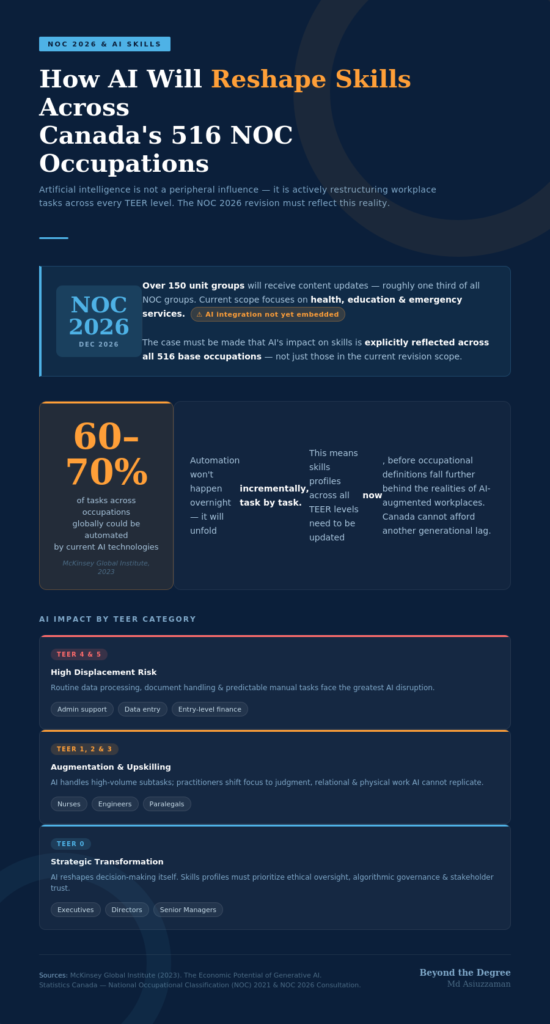
For TEER 1, 2, and 3 occupations, including technicians, skilled tradespeople, paralegals, nurses, and engineers, the impact of AI is more nuanced. AI will assume responsibility for lower-complexity, high-volume subtasks such as drafting routine reports, reviewing documentation, and retrieving regulatory references. This shift enables practitioners to concentrate on judgment-intensive, relational, and physical tasks that AI cannot replicate. The NOC skills profiles for these roles should explicitly prioritize AI collaboration literacy—the ability to prompt, interpret, audit, and apply AI-generated outputs—as a core competency.
For TEER 0 management occupations, the transformation is particularly significant. AI alters not only managerial tasks but also the decision-making process itself. Skills profiles must therefore emphasize strategic discernment, ethical oversight of algorithmic systems, and the uniquely human ability to build stakeholder trust—competencies beyond the scope of current language models.
The Conference Board of Canada has observed that the country’s workforce development ecosystem has historically lagged in updating occupational standards to reflect real-time shifts in skill requirements (Conference Board of Canada, 2022). The NOC 2026 revision presents a meaningful opportunity to begin addressing this gap — and the subsequent major structural revision, scheduled for 2031, will be the most consequential in the framework’s history if AI literacy is embedded at its core.
For Newcomers, Skills Are the Bridge
Consider again the immigrants represented in the data. Canada’s youngest adults, aged 25–34, have seen significant growth in master’s degree attainment, reaching 14%, up from 11% in 2019 — though still slightly below the OECD average of 16% (OECD, 2025). Newcomers frequently possess equivalent or superior academic credentials. However, credentials alone do not provide access to workplace culture, professional networks, or the unwritten norms of an industry.
The skills gap experienced by newcomers is genuine but can be addressed. Addressing this gap requires deliberate investment in contextual workplace competencies, sector-specific AI literacy, professional communication tailored to Canadian contexts, and the relational capital developed through structured mentorship and community engagement.
As a career educator, I identify the greatest potential for impact in this area. Skills-based recognition frameworks, already piloted in sectors such as healthcare and engineering, should be expanded. Micro-credentials, competency-based assessments, and stackable certifications aligned with NOC skill profiles provide a more effective bridge between newcomer potential and employer confidence than traditional credential-matching exercises.
Conclusion: The Skills Imperative
The credential inflation crisis in Canada persists. However, it highlights a critical insight: skills constitute the true unit of labour-market value, and current measurement practices have been misaligned for too long.
As AI transforms the task composition of all 516 NOC unit group occupations, the NOC 2026 revision — and the structural overhaul planned for 2031 — will either modernize the understanding of human-AI collaboration or perpetuate a skills mismatch that could disadvantage workers, particularly newcomers, for an entire generation.
The solution does not lie in reducing the number of degrees awarded, as domain knowledge and critical thinking are as important as ever before. Instead, it requires a more precise, transparent, and dynamic dialogue about the skills truly needed, the mechanisms for recognizing them, and strategies for bridging the gap between individual capabilities and market demands. Initiating this conversation is imperative.
(The writer is a career development professional and AI practitioner helping new graduates, job seekers, and newcomers to Canada navigate the modern job market with confidence. He holds multiple AI certifications and brings a practical, human-centred approach to career readiness in an AI-driven world.)
References
- Akbar, S., & Triandafyllidou, A. (2025). Credential recognition and labour market integration of immigrants in Canada—Institute for Research on Public Policy.
- Cambridge Dictionary. (2024). Skill. Cambridge University Press. https://dictionary.cambridge.org/dictionary/english/skill
- Conference Board of Canada. (2022). Skills and workforce development in Canada: Closing the gap. https://www.conferenceboard.ca/focus-areas/education-skills/
- McKinsey Global Institute. (2023). The economic potential of generative AI: The next productivity frontier. McKinsey & Company. https://www.mckinsey.com/capabilities/mckinsey-digital/our-insights/the-economic-potential-of-generative-ai-the-next-productivity-frontier
- OECD. (2019). OECD skills outlook 2019: Thriving in a digital world. OECD Publishing. https://doi.org/10.1787/df80bc12-en
- OECD. (2025). Education at a glance 2025: OECD indicators. OECD Publishing. https://doi.org/10.1787/eag-2025-en
- Statistics Canada. (2021). National Occupational Classification (NOC) 2021. Government of Canada. https://www.statcan.gc.ca/en/subjects/standard/noc/2021/index
- Statistics Canada. (2026, March 25). Educational attainment in Canada has continued to rise over the past decade, 2025. The Daily. https://www150.statcan.gc.ca/n1/daily-quotidien/260325/dq260325c-eng.htm
- World Economic Forum. (2023). The future of jobs report 2023. World Economic Forum. https://www.weforum.org/publications/the-future-of-jobs-report-2023/
AI Use Disclosure
This blog post was researched and drafted with the assistance of multiple AI tools. The author reviewed, verified, and edited all content, including the synthesis of source materials, in-text citations, and conclusions. All referenced documents were provided by the author and interpreted with professional judgment. AI-assisted drafting was used to support efficiency and clarity, not to replace critical analysis or subject-matter expertise.