


Canada has always been a sought-after destination for students from around the globe. However, recent Statistics Canada data reveal a significant and transformative shift in these students’ preferences. Between the academic years of 2014/2015 and 2023/2024, public colleges in Canada have experienced remarkable growth in international student enrolment. This surge not only reflects massive increases in numbers but also highlights changes in student demographics, geographic preferences, and chosen fields of study, reshaping the landscape of Canada’s post-secondary education.

The Enrollment Revolution and the Slowdown
Just a decade ago, public colleges had a lesser role in attracting international students. Back in 2014/2015, only 26.7% of all international post-secondary students in Canada enrolled in public colleges. Fast forward to the academic year 2023/2024, and this figure has nearly doubled to 50.4%.
In terms of raw numbers, the rise is astonishing. Public colleges welcomed 58,125 international students in 2014/2015, rising to 288,798 by 2023/2024. This trend indicates that public colleges have become the go-to destinations for students seeking Canadian credentials.
A Transformative Shift in Student Demographics
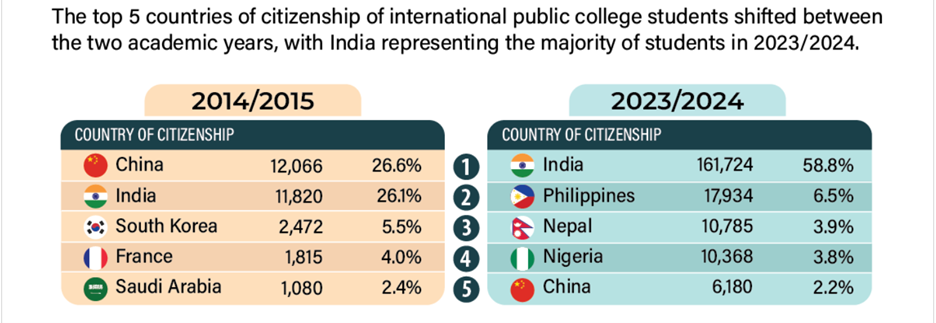
The nationalities of international public college students have also seen a dramatic transformation over the last decade. In 2014/2015, the competition was tight between China and India, with China at 26.6% and India at 26.1% of the total enrolment.
However, as we look towards 2023/2024, one nation stands out: India. Indian students now represent a striking 58.8% of the international student population in public colleges, totalling 161,724 students. Conversely, China, which once held a strong position, has dropped to fifth place, accounting for just 2.2% of total enrolment (6,180 students).
The diversity among the top countries also expanded in 2023/2024, with students from the Philippines (6.5%), Nepal (3.9%), and Nigeria (3.8%) joining. A decade ago, South Korea, France, and Saudi Arabia rounded out the top five, showcasing the evolving preferences of international students.
As we continue to monitor these trends, it’s clear that public colleges in Canada are leading the charge in attracting a diverse and growing group of international students, marking an exciting new era in postsecondary education.
Provincial Concentration and Academic Pursuits
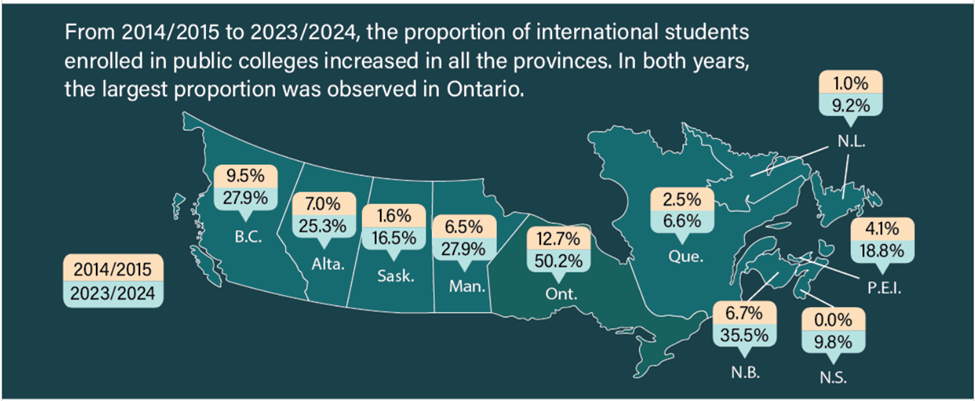
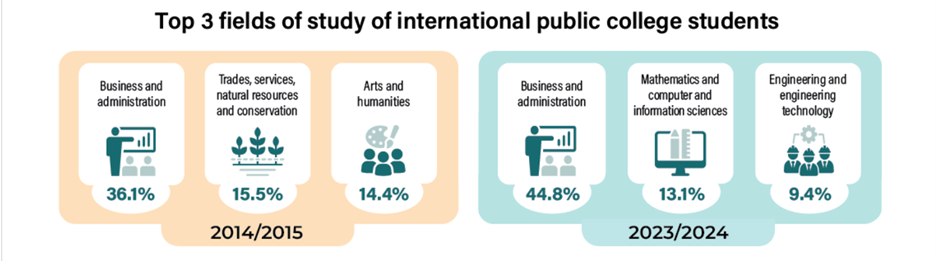
Ontario stands out as the primary hub for these students, consistently drawing the largest share year after year. In the 2023/2024 academic year, an impressive 50.2% of all international public college students were enrolled in Ontario—an increase from just 12.7% nine years prior. Other provinces also experienced notable growth, particularly New Brunswick, which surged from 6.7% to 35.5%, and Prince Edward Island, which climbed from 4.1% to 18.8%. When it comes to academic preferences, Business and Administration remained the leading field of study for international students, with its share rising from 36.1% in 2014/2015 to 44.8% in 2023/2024. This enduring popularity solidifies it as a sought-after discipline among aspiring students.
Interestingly, there has been a notable shift in the second and third-most-popular fields, reflecting a growing interest in specialized technical training. In the earlier academic year, the secondary fields comprised Trades, Services, Natural Resources, and Conservation (15.5%) and Arts and Humanities (14.4%). Fast forward to 2023/2024, these areas have been overtaken by Mathematics and Computer and Information Sciences (13.1%) and Engineering and Engineering Technology (9.4%). This trend indicates an increasing demand from international students for programs aligned with Canada’s technology-driven job market and skilled labour needs.
It’s essential to note that Statistics Canada data includes non-Canadian students with study permits, various types of visas, and those with refugee or unknown status. Note that data for the territories is not included in this analysis.
Policy Context and Future Outlook
The rapid, regionally concentrated growth of international students, as highlighted in the 2023/2024 data, has brought the international student program under significant public scrutiny. This influx not only contributes billions of dollars to the Canadian economy but also helps address pressing labour shortages. However, the unprecedented rise in international students is placing extraordinary strain on housing, infrastructure, and institutional quality control—especially in provinces like Ontario, where growth has been particularly pronounced.
Looking Ahead
As we look ahead, understanding these dynamics will be crucial for policymakers and educational institutions alike, ensuring that the benefits continue while managing the challenges associated with this rapid growth.
In early 2024, the Canadian federal government introduced a temporary two-year cap on new international student study permits. This move aims to address the systemic pressures from rapid growth in international student numbers. The government expects a nationwide reduction of about 35% in the number of new international students in 2024.
Additionally, changes have been made to post-graduation work permits. These changes affect students in public-private partnership programs and those enrolled in specific non-degree courses. The government’s policies respond to trends indicated in the Statistics Canada report. The data show significant growth in international education through 2023/2024.
The Statistics Canada report reveals a historic surge in international education. It highlights that public colleges, driven by demand from countries like India, are now key players in Canada’s global education strategy.
Postscript: At the time I prepared this article, Canada announced its cap on international student allocations for 2026. Next year, Canada will issue only 155,000 new study permits, bringing the total to 498,000, including 253,000 renewal and returning students. The number is 7% lower than in 2025 (437,000) and 16% lower than in 2024 (485,000). According to Statistics Canada, the country’s temporary population, which includes international students, dropped from 1 million in January 2024 to 725,000 in September 2025.
(Disclaimer: Multiple AI tools are used in research, analysis and writing this article.)