

Md Asiuzzaman | Career Educator & International Students Advisor
In today’s competitive North American job market, your resume is more than just a record of your work; it’s your personal marketing tool that can significantly affect your chances of securing an interview and landing a job. Recent research from Huntr, which analyzed over 1.39 million job applications, offers valuable insights that challenge traditional resume advice and provide a clear guide for job seekers across Canada and the United States.
Your Resume: A Strategic Self-Marketing Tool
Think of your resume as your initial sales pitch to potential employers. It’s not just a list of qualifications; it’s a marketing tool meant to tell your professional story and convince hiring managers that you are a strong candidate. The best resumes serve as engaging narratives, highlighting your unique value and demonstrating how your experience, skills, and achievements align with employer needs. It should serve as your personal brand statement, designed to capture attention, establish trust, and generate sufficient interest to secure that vital interview invitation.
Why Many Job Seekers Miss the Mark
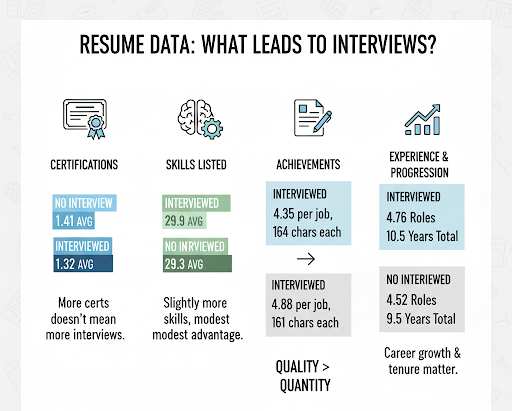
Unfortunately, many job seekers make common mistakes that diminish the effectiveness of their resumes. The data shows that unsuccessful candidates often focus on quantity rather than quality. They list many skills and collect numerous certifications, but fail to provide sufficient context. Specifically, resumes that were unable to secure interviews contained more certifications (1.41 vs. 1.32 on average), yet did not convey a compelling professional story. Moreover, these candidates often listed more achievements (4.88 per job) but provided less detail (averaging 161 characters each), missing key chances to show real impact. The main takeaway is that employers value strong storytelling over long lists of skills.

The infographic is AI-generated based on the information provided.
The harsh reality of job searching is also reflected in the statistics. Even well-prepared resumes have low conversion rates. Generic resumes, for instance, achieve only a 2.68% conversion rate from application to interview or offer stage. This means fewer than 3 interviews for every 100 applications. This low success rate can be discouraging, often pushing job seekers to apply to more positions with the same ineffective method rather than refining their strategy. However, the data show that proven methods exist to significantly improve your success rate.
The Game-Changing Power of Customization
The data reveals an important point here: Tailored resumes lead to 2.1 times higher interview conversion rates. Job seekers who customize their resumes for specific jobs experience an impressive 5.75% conversion rate, which is more than double the success rate of generic submissions. This translates to approximately six interview opportunities for every 100 applications, compared to fewer than three for generic resumes. This 115% improvement in success rates clearly shows that personalization is not just beneficial; it is crucial in today’s hiring market. Each application deserves a resume carefully crafted to meet the job requirements and the company culture.
The infographic is AI-generated based on the information provided.
Top Tips to Secure More Job Interviews
Based on thorough data analysis, here are strategies to increase your interview potential:
• Focus on Quality Over Quantity: Aim for fewer, but more detailed, achievements. The data suggests 4-5 achievements per role with rich descriptions averaging 164 characters.
• Embrace the Two-Page Resume: Contrary to outdated advice, two-page resumes actually have the highest success rate at 3.69%. Therefore, don’t feel constrained by the one-page rule if your experience requires more space.
• Craft Concise, Focused Summaries: Include a professional summary (94% of successful candidates do), but keep it short. About 524 characters work best.
• Provide a Detailed Educational Background: Expand your educational descriptions to roughly 100 characters, providing context about relevant coursework, projects, or academic achievements.
• Highlight Career Progression: Show your professional growth and experience. Successful candidates have an average of 10.5 years of experience across 4.76 roles.
The true path to interview success lies not in following outdated rules but in understanding what the data reveals about employer preferences. By treating your resume as a strategic marketing tool, focusing on quality, and customizing each application, you can significantly boost your chances of landing those crucial interviews in the competitive North American job market.
(The writer is a Professor of Career Development based in Toronto, Canada. Multiple AI tools are used in the research, analysis, and writing of this article.)