


Md Asiuzzaman
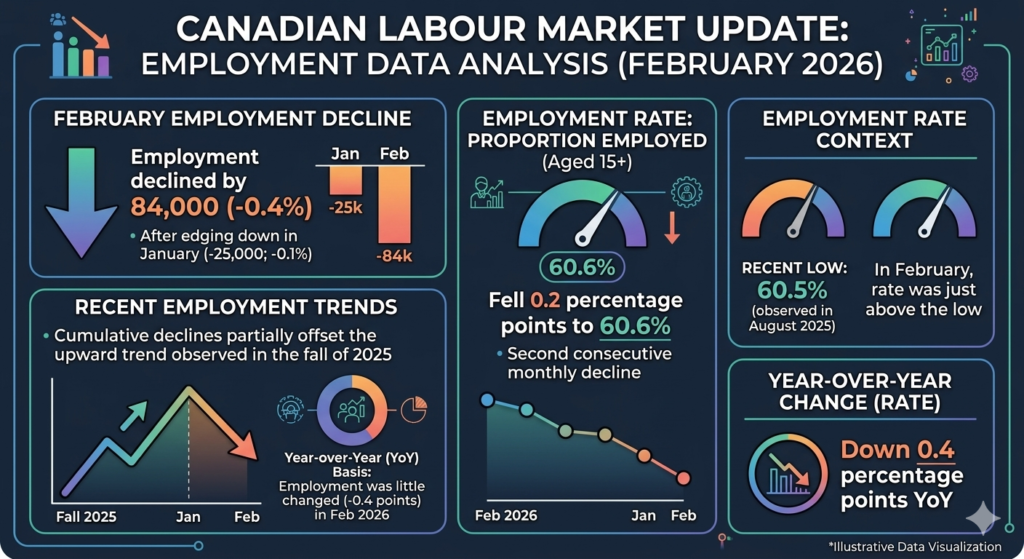
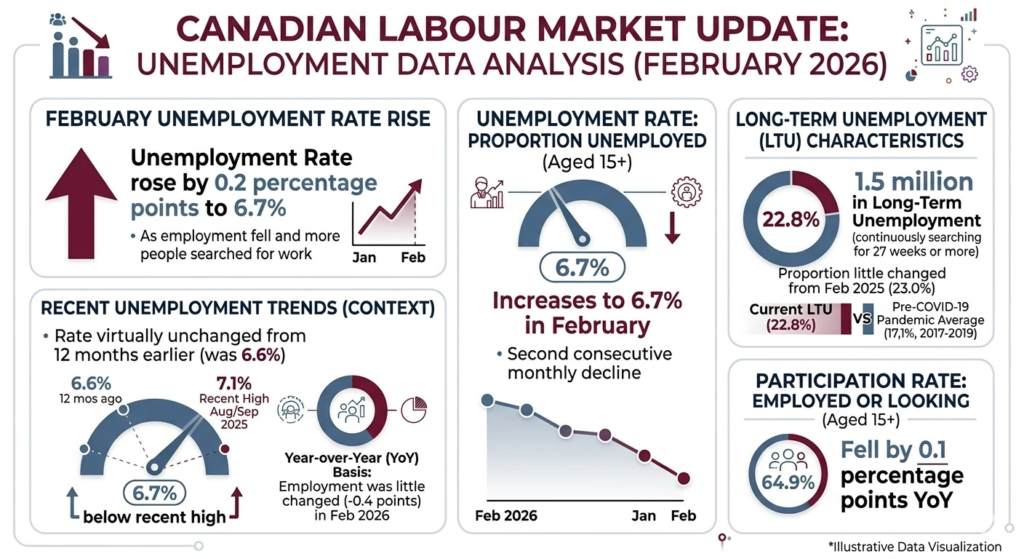
Canada lost 84,000 jobs in February 2026, pushing the unemployment rate to 6.7%, according to Statistics Canada. Across North America, white-collar workers are being laid off at companies that have recently reported record revenue. Students and job seekers frequently ask: Is AI taking our jobs? Which careers are secure? What should I study now? This post aims to provide a clear, research-based guide for navigating what many commentators now call a ‘Great Recession for white-collar workers’ (Fortune, 2026).
In short, the situation is serious but not catastrophic. This article explains what is happening, who is most at risk, and, most importantly, what actions you can take.
The White-Collar Recession: Separating AI Hype from Financial Reality
Before we panic about robots stealing our jobs, it is worth understanding why those 84,000 Canadian jobs disappeared. A growing body of evidence suggests that, in the short term, AI is not replacing white-collar workers so much as displacing the budgets that used to pay them. As technology writer Catherine Baab (2026) argues, companies like Oracle, Microsoft, and Amazon are cutting tens of thousands of corporate employees not because AI can already do their jobs, but because spending on AI data centres and infrastructure is so enormous that labour costs must be slashed to fund it. Oracle, for instance, is reportedly planning up to 30,000 layoffs while simultaneously taking the company’s cash flow negative to fund data centre expansion (Baab, 2026).
In summary, current job losses are due not to ChatGPT, Claude or Gemini but to ‘chip orders, lease commitments, bond offerings, server farms, spades in the ground’ (Baab, 2026, para. 11). The displacement is real, even though full technological replacement has not yet occurred.
For young Canadians entering the workforce, this distinction is significant. The primary concern is not that AI is more capable, but that corporate priorities have shifted, resulting in reduced white-collar hiring budgets.
How Exposed Is Your Future Career? The Gap Between Theory and Reality
Anthropic researchers Massenkoff and McCrory (2025) introduced a critical new concept: observed exposure, a metric that compares what AI tools theoretically could do with what they do in professional workplaces. Their findings are both reassuring and alarming.
The reassuring part: AI is far from reaching its theoretical capacity. Despite AI models being technically capable of handling most tasks across business and finance, management, computer science, legal, and office administration roles, actual adoption in practice remains a small fraction of that potential (Massenkoff & McCrory, 2025). Claude, for example, currently covers just 33% of all tasks in the Computer & Math occupational category, despite a theoretical capability rate of 94% (Massenkoff & McCrory, 2025).
The concerning aspect is that AI adoption is accelerating, and the gap between potential and actual use will close. Researchers attribute the current lag to legal constraints, technical challenges, and the ongoing need for human review, all of which are temporary barriers (Massenkoff & McCrory, 2025). As capabilities improve and deployment increases, actual usage will approach theoretical potential.
Perhaps most strikingly, the workers most exposed to AI displacement are not the low-wage, low-skill workers most people picture. The most AI-exposed group is 16 percentage points more likely to be female, earns 47% more on average, and is nearly four times as likely to hold a graduate degree (Massenkoff & McCrory, 2025). The exposed worker is the lawyer, the financial analyst, the software developer — not the warehouse worker.
There is also an early warning for young workers. Massenkoff and McCrory (2025) found evidence of a 14% decline in the job-finding rate for workers aged 22–25 in AI-exposed occupations since the release of ChatGPT in late 2022. Older workers in similar roles have not experienced this decline. This indicates that AI may be limiting entry-level opportunities for new graduates.
Declining Occupations: Roles Under Pressure
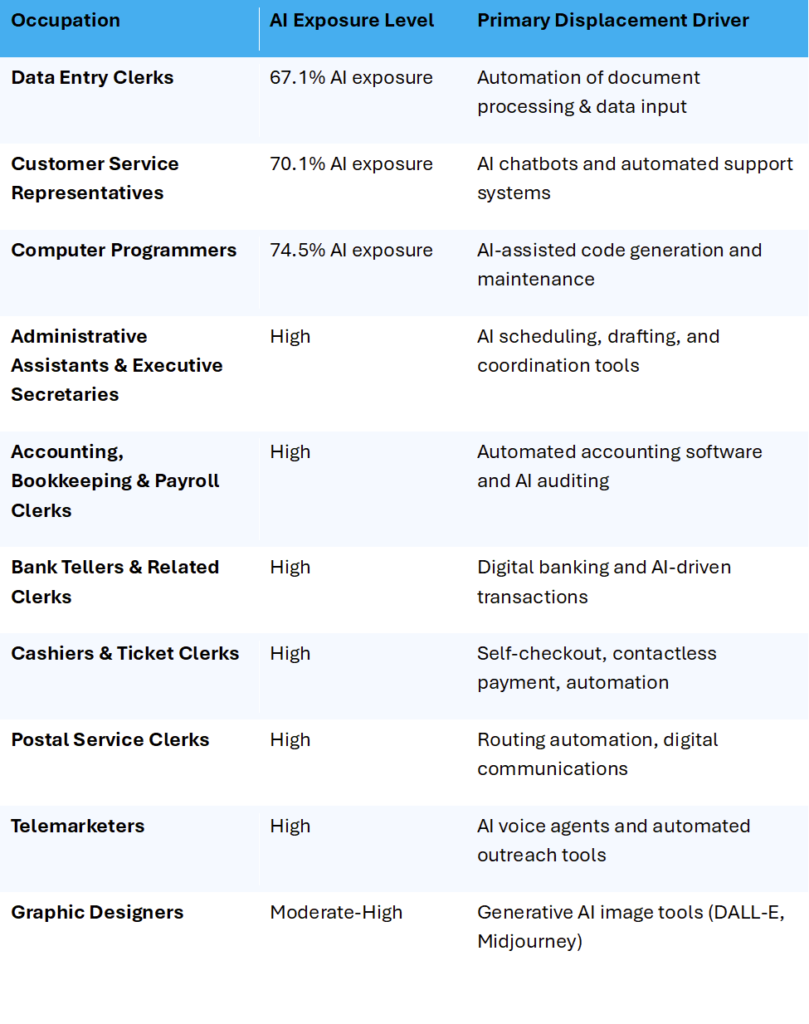
Based on the convergence of data from Massenkoff and McCrory (2025) and the World Economic Forum’s Future of Jobs Report 2025, the following occupational categories are projected to experience the steepest decline by 2030. The primary drivers are AI and information processing, broadening digital access, and robotics and automation (World Economic Forum [WEF], 2025).
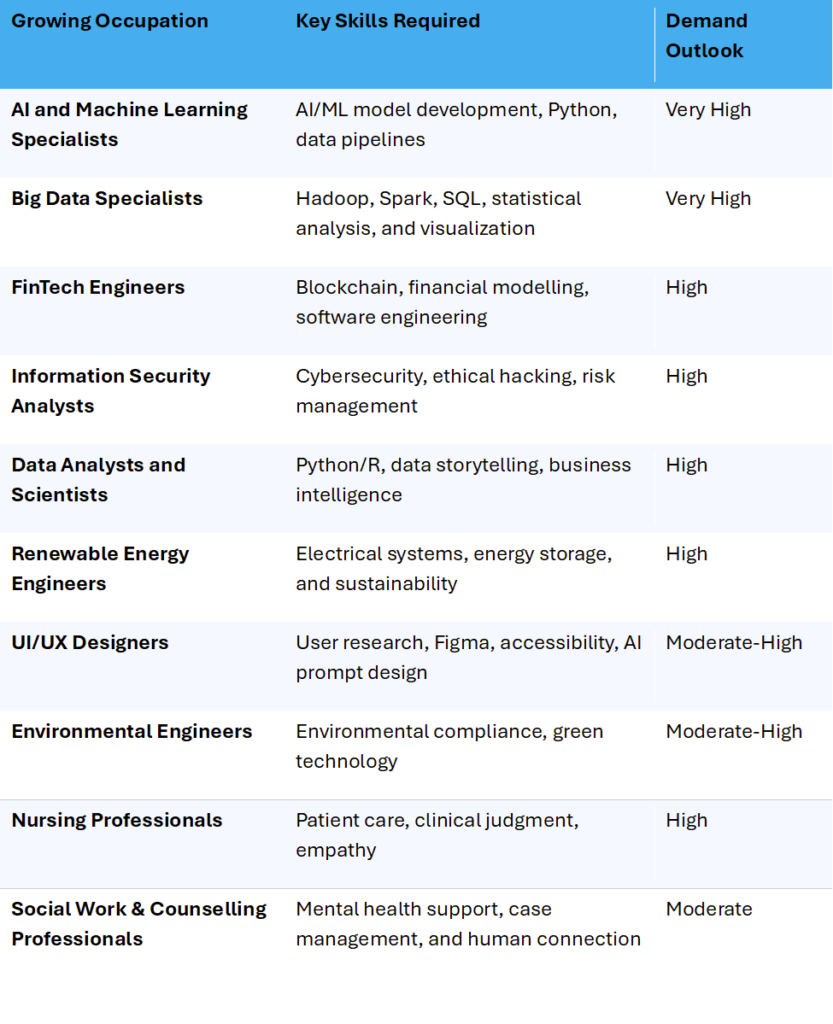
Growing Occupations: Where the Opportunities Are
The same forces disrupting old jobs are creating new ones. The same trends that are eliminating some jobs are also creating new opportunities. The WEF (2025) estimates that by 2030, macrotrend-driven job creation will add 170 million new roles globally, offset by the loss of 92 million current roles, resulting in a net gain of 78 million jobs. The fastest-growing occupations are in technology, green energy, healthcare, and care work (WEF, 2025). They are associated with skills (WEF, 2025; Massenkoff & McCrory, 2025).
The Skills That Will Set You Apart
The WEF (2025) identifies three skill categories as the fastest growing between 2025 and 2030: AI and big data literacy, networks and cybersecurity, and technological literacy. However, the requirements extend beyond simply ‘learning to code.’
Technical Skills (Baseline Requirements)
- AI and machine learning fundamentals: While building large language models is not required, it is important to understand how to prompt, evaluate, and use AI tools in professional settings.
- Data analysis and visualization: Proficiency in Python, SQL, and tools such as Tableau or Power BI is now expected across industries, not only for data scientists.
- Cybersecurity awareness: Information security is among the top five fastest-growing roles globally (WEF, 2025). Even non-specialists benefit from foundational cybersecurity knowledge.
- Cloud and platform literacy: Familiarity with AWS, Azure, or Google Cloud is becoming a standard expectation in technology-related roles.
Human-Centred Skills (Your Competitive Advantage Over AI)
The WEF (2025) notes that resilience, flexibility, and agility are among the key skills distinguishing growing from declining jobs. These abilities cannot be automated. Equally important are the following:
- Critical thinking and creative problem-solving: AI can generate options; it struggles to navigate truly novel or ethically complex situations.
- Interpersonal communication and leadership: Relationship management, persuasion, and mentoring are human skills that become increasingly valuable as AI takes on routine cognitive tasks.
- Emotional intelligence and social services: Care economy roles in nursing, counselling, and social work are among the highest-growth categories (WEF, 2025), driven by an aging population and the irreplaceable nature of human empathy.
- Adaptability and continuous learning: The Huntr (2025) Q2 job search report found that 93% of job seekers already use AI tools for resume writing and interview preparation. Those who view learning as a core professional skill will be best positioned for success.
Practical Job Search Skills in the New Market
Q2 2025 job market data shows that the median time to receive a first job offer has increased by 22% to 68.5 days (Huntr, 2025). Candidates who secure interviews typically have resumes with detailed achievements, longer average tenure, and a stronger LinkedIn presence, emphasizing depth over breadth (Huntr, 2025). As AI-generated resumes become more common, human authenticity and proven results are key differentiators.
Six Practical Steps for Young Job Seekers in the AI Age
As a career development practitioner, drawing on research from Anthropic, the WEF, and current job market data, I have the following recommendations for students and early-career professionals:
- Assess your target role’s AI exposure. Before choosing a career path, determine if it appears on high-exposure lists. If so, identify tasks within the role that are resistant to automation and focus on developing those skills.
- Pursue T-shaped skill development. Develop deep expertise in one area while building broad AI and data literacy across multiple domains. Both technical and human skills are necessary.
- Pursue credentials strategically. The Huntr (2025) job market analysis shows that advanced degrees (master’s and doctorates) yield salary premiums of 29–35%, and AI or engineering strategy skills command premiums of over 100% above average. However, Khan Academy CEO Salman Khan cautions that even a 10% reduction in white-collar jobs due to AI would ‘feel like a depression,’ warning against assuming any single credential offers complete protection (as cited in Fortune, 2026).
- Target growth sectors intentionally. The WEF (2025) identifies green technology, healthcare, cybersecurity, and AI-related roles as the highest net-growth categories. Aligning your career with these structural trends will provide greater long-term benefits than focusing solely on current job openings.
- Develop a visible portfolio in addition to your resume. In a market saturated with AI-enhanced applications, tangible work such as Google Sites, GitHub repositories, published analyses, projects, and volunteer contributions demonstrates genuine capability beyond what a resume can convey.
- Invest in your professional network early. Massenkoff and McCrory (2025) found that the hiring slowdown for young workers developed gradually. Building professional relationships, securing mentors, and establishing your presence in your target field are most effective before beginning an active job search.
Conclusion: Be the Human in the Loop
The evidence tells us something both cautionary and genuinely hopeful. AI is real, its impact on white-collar work is real, and the early signals — including Canada’s February job losses and the declining entry-level hiring rate for young workers in AI-exposed roles — should be taken seriously. The ‘white-collar recession’ is not alarmism; it is a reasonable description of the structural shift underway.
A key insight from Massenkoff and McCrory (2025) is that actual AI adoption remains far below its theoretical capability. There is a significant gap between what AI could do and what it currently does in workplaces. This gap provides time to develop the skills, credentials, and networks needed to remain resilient as AI adoption increases.
The workers who will succeed are those who can use AI, interpret its outputs, identify its errors, and provide the human judgment, creativity, and connection that AI cannot replicate. Begin developing these capabilities now. Consider the gap as your opportunity. There will always be a human in the loop because AI can not do critical thinking. You become the human in the AI loop.
References
- Baab, C. (2026, March 6). AI isn’t taking people’s jobs: Here’s what’s really happening. Quartz. https://quarz.com/ai-jobs-white-collar-layoffs-2026
- Fortune. (2026, February 12). 3 factors that will separate the ‘SaaSpocalypse’ winners from losers. Fortune CEO Daily. https://fortune.com/2026/saaspocalypse-winners-losers
- Fortune. (2026, March 2). Anthropic just mapped out which jobs AI could potentially replace: A ‘Great Recession for white-collar workers’ is absolutely possible. Fortune. https://fortune.com/2026/anthropic-ai-jobs-great-recession-white-collar
- Huntr. (2025). Job search trends report Q2 2025. Huntr Research. https://huntr.co/research/job-search-trends-q2-2025
- Massenkoff, M., & McCrory, P. (2025). Labour market impacts of AI: A new measure and early evidence. Anthropic. https://doi.org/10.48550/arXiv.2504.08837
- World Economic Forum. (2025). Future of jobs report 2025 (ISBN 978-2-940631-90-2). World Economic Forum. https://www.weforum.org/reports/the-future-of-jobs-report-2025/
AI Use Disclosure
This blog post was researched and drafted with the assistance of multiple AI tools. The author reviewed, verified, and edited all content, including the synthesis of source materials, in-text citations, and conclusions. All referenced documents were provided by the author and interpreted with professional judgment. AI-assisted drafting was used to support efficiency and clarity, not to replace critical analysis or subject-matter expertise.