

By Md Asiuzzaman
(Updated with a rewrite and citations)
If your parents and grandparents are Baby Boomers, you might have noticed they retired from the same company where they started their careers after graduation. That is no longer the case because careers are no longer linear.
Historically, obtaining a bachelor’s degree has been closely associated with securing stable, white-collar employment. It was widely regarded as the most reliable path to workforce entry and as a way to reduce the risk of unemployment. That is again changing with the shrinking job market and the rapid growth of AI.
For the graduating class of 2025, conditions have changed significantly. As of November 2025, Canada’s overall unemployment rate is 6.5%, while youth unemployment approaches 13%.
Statistics Canada data indicate that this is more than a temporary slowdown; it reflects a ‘structural realignment of early-career work’ (Statistics Canada, 2025). Increasingly, highly qualified young individuals, referred to as the “Eligible Bachelors,” are encountering greater difficulty transitioning from university to stable employment as job openings diminish.
Vanishing Jobs
The “Eligible Bachelor”, as the term coined in the LMIC Blog headline, is characterized by a surplus of qualified graduates relative to the limited number of available job openings.
Canada has the highest percentage of the population with tertiary degrees. Meanwhile, the number of young Canadians aged 15 to 24 holding bachelor’s degrees has reached an all-time high, while corresponding job opportunities are declining rapidly.
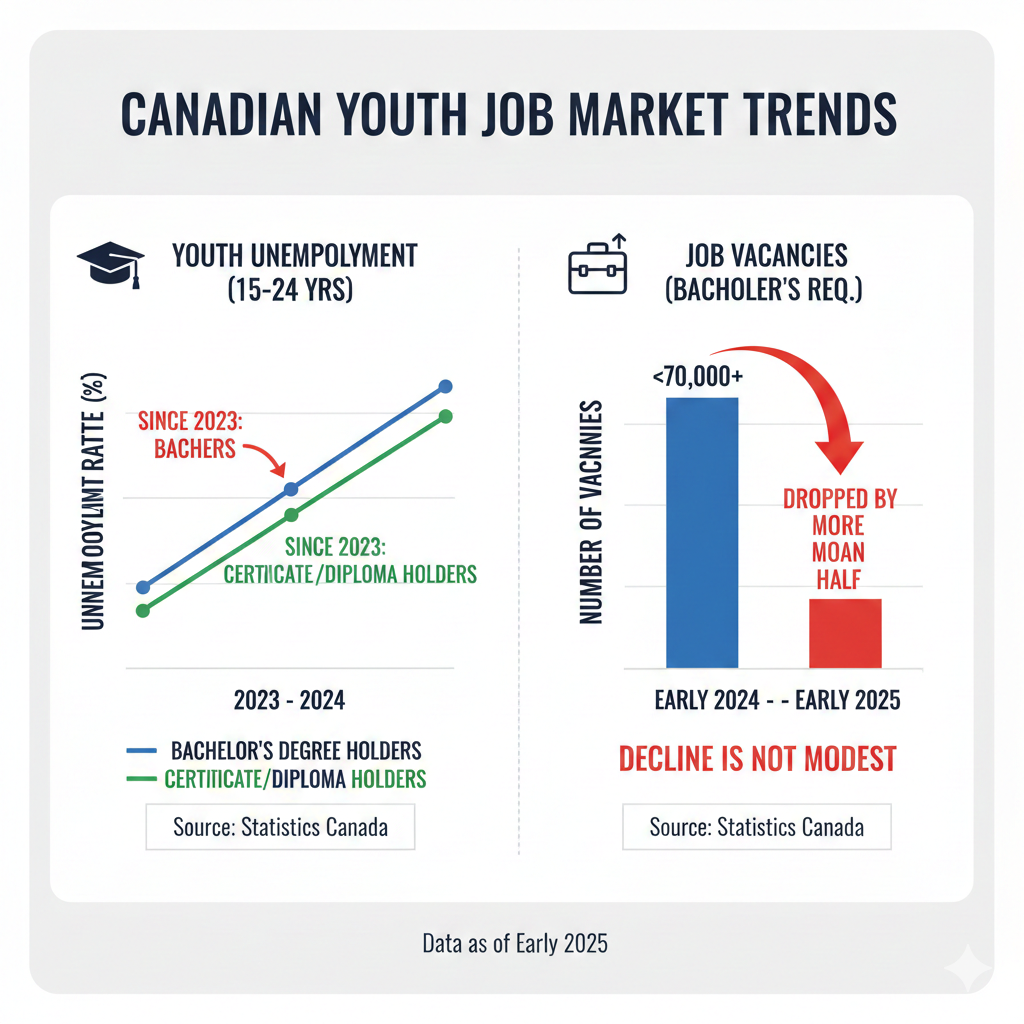
Since early 2024, vacancies for jobs requiring a bachelor’s degree and fewer than 3 years’ experience have declined substantially. According to Statistics Canada, job vacancies in Canada fell to 524,300 in the first quarter of 2025, a decrease of 20,600 jobs or 3.8 percent compared to the previous quarter. This reduction in available positions could affect early-career opportunities for many young people.

Where Did the Jobs Go?
The reduction in job openings is particularly evident in fields that traditionally served as entry points for new graduates. Sectors such as business, policy, software, and data science now offer significantly fewer positions (Nelson & Yang, 2025).
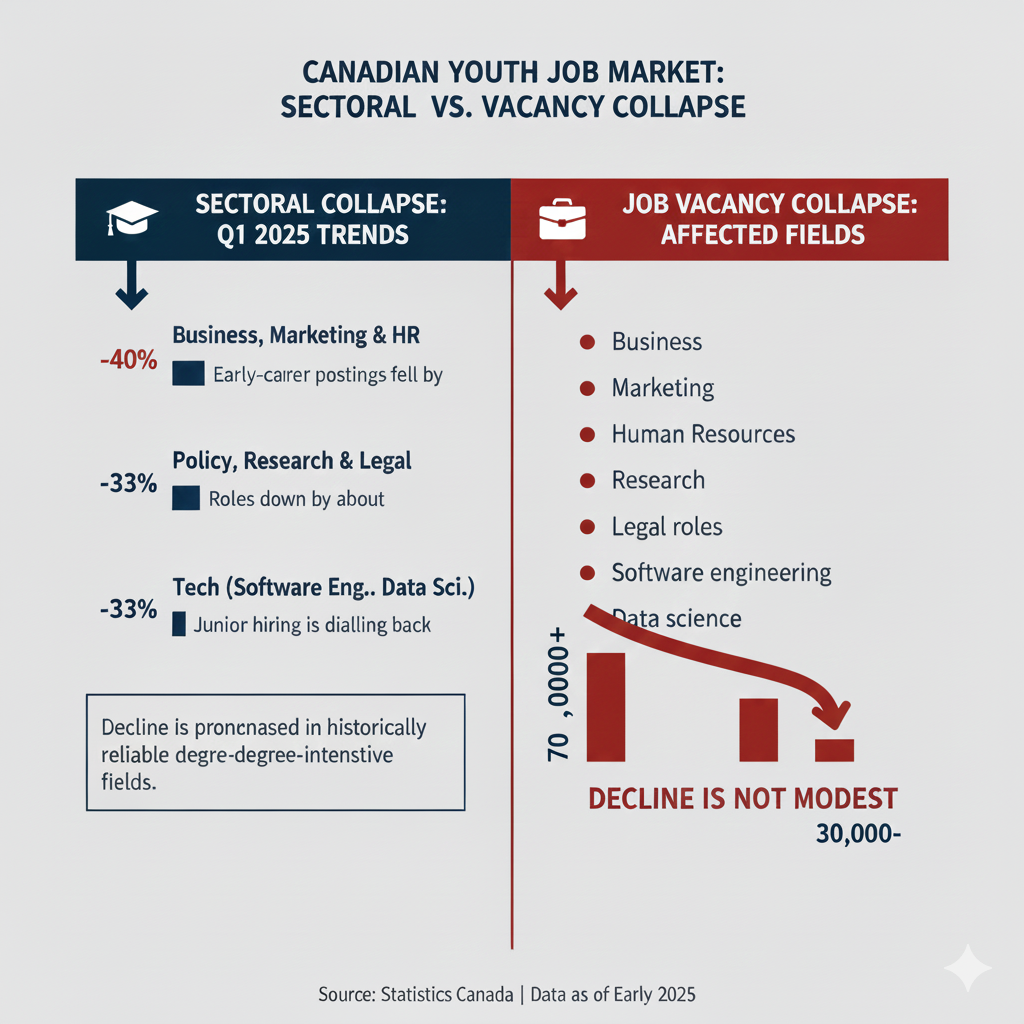
For instance, postings for entry-level positions in business, marketing, and human resources declined by nearly 40% in the first quarter of 2025. Policy, research, and legal roles experienced a reduction of approximately one-third (Nelson & Yang, 2025). Even software engineering and data science, previously considered high-growth sectors, are now reducing junior hiring.
A primary factor contributing to this shift is the increasing integration of Artificial Intelligence (AI) in the workplace (Mehdi & Morissette, 2024). Generative models and machine-learning systems are now capable of performing tasks previously assigned to entry-level employees, such as drafting, summarizing, coding, and analyzing (Smith, 2024).
Under these circumstances, employers may prefer not to hire inexperienced workers when more experienced individuals or AI tools can complete tasks more efficiently (Levanon et al., 2025).
Previously, beginning a career often involved learning and mentorship; however, automation and organizational restructuring are now predominant. A similar trend is observed in the United States, where automation is reducing the number of entry-level positions, and employers increasingly seek experienced candidates over recent graduates (Levanon et al., 2025).
The Flipped Premium: A Rare Inversion
Unemployment statistics offer clear evidence of these changing dynamics.
For many years, university graduates had lower unemployment rates than those with college diplomas or trade certificates. According to Statistics Canada, in September 2025, the unemployment rate among youth aged 15 to 24 years reached 14.7 percent, marking the highest level for that month since 2010.
This reversal is atypical. While holding a degree may confer long-term benefits, many “Eligible Bachelors” face significant barriers today.
According to a report from Canada.ca, many individuals with trades credentials are finding employment opportunities in the skilled trades sector, which is expected to remain strong as 700,000 skilled trades workers are set to retire between 2019 and 2028.
Insulated from automation: Skilled trades and Healthcare.
Key details of these sectors:
- This resilience is notable when compared to overall youth employment trends in Canada, where the full-time, permanent employment rate for non-student youth aged 15 to 24 was 50.7% in 2023, according to Employment and Social Development Canada.
- Individuals holding certificates or diplomas are commonly employed in these sectors, which demonstrate considerable employment. In these sectors, employment typically involves hands-on tasks that are difficult to outsource or automate.
- There is steady demand for workers in healthcare, such as nurses, and in skilled trades, such as electricians, plumbers, and HVAC technicians (Canadian Apprenticeship Forum, 2024).
- While AI is changing many white-collar jobs, demand for workers in healthcare and skilled trades is still steady.
Scope of the Decline
The pronounced decline in entry-level positions for degree holders indicates increasing difficulty in transitioning from university to stable white-collar employment.
According to Statistics Canada, between early 2024 and early 2025, job vacancies for positions requiring a bachelor’s degree or higher declined by 10,700 or 11 percent, and the number of unemployed people with a bachelor’s degree or higher increased by 80,000.
This substantial reduction in job opportunities coincides with a growing number of young Canadians aged 15 to 24 earning bachelor’s degrees. The resulting gap may delay or disrupt the early career progression of thousands of young individuals.
Sectoral Collapses
The decline in job availability is particularly pronounced in fields that traditionally served as entry points for new graduates. These “degree-intensive fields” have contracted:
Early-career postings for business, marketing, and human resources jobs fell by nearly 40% in the first quarter of 2025 (Nelson & Yang, 2025).
According to ByteIota, entry-level software engineering hiring declined by 73% in 2025, as AI tools increasingly automated routine tasks once the responsibility of junior developers.
This rapid decline is attributed to several interconnected factors, including automation, evolving employer preferences, and global economic uncertainty.
The most prominent explanation for the pullback in junior hiring is the rise of Artificial Intelligence (AI) in the workplace (Mehdi & Morissette, 2024).
Automation of Entry-Level Tasks: Generative models and machine-learning systems can now perform many tasks traditionally assigned to new staff. These tasks include drafting, summarizing, coding, and analyzing (Smith, 2024).
As these technologies become more prevalent, employers may be less inclined to hire inexperienced candidates. They may instead select individuals with greater experience who can collaborate with advanced systems or utilize AI tools to complete tasks more efficiently (Levanon et al., 2025).
Consequently, initial employment opportunities for graduates, once centred on learning and mentorship, are increasingly influenced by automation and organizational changes. A similar pattern is evident in the United States, where automation is reducing the number of entry-level positions, and employers prefer more experienced workers (Levanon et al., 2025).
Collectively, these trends demonstrate that obtaining a bachelor’s degree, previously regarded as the most reliable route to stable employment, no longer ensures a straightforward entry into the workforce.
The specific fields experiencing vacancy collapse are:
- Business
- Marketing
- Human Resources
- Policy
- Research
- Legal roles
- Software engineering
- Data science
The Way Forward
The implications are evident: if young Canadians are unable to secure employment commensurate with their qualifications, many may become underemployed, pursue further education, or delay labour market entry.
Degrees still offer long-term advantages, but they no longer make it easy to start a career. For policymakers and educators, this means the move from school to work is now more complicated and harder to predict.
To prevent a generation of talent from being marginalized, Canada must offer current, job-level labour market information. Such data will enable students to make informed decisions throughout their educational and early-career pathways and beyond.
References
- Canadian Apprenticeship Forum. (2024). Apprentice demand in Red Seal trades: A 2024 national labour market information report. https://caf-fca.org/research_reports/executive-summary-apprentice-demand-in-red-seal-trades-a-2024-national-labour-market-information-report/
- Levanon, G., Sigelman, M., Mamertino, M., de Zeeuw, M., & Guilford, G. (2025). No country for young grads: The declining value of a college degree in the U.S. The Burning Glass Institute. https://www.burningglassinstitute.org/research/no-country-for-young-grads
- Mehdi, T., & Morissette, R. (2024). Experimental estimates of potential artificial intelligence occupational exposure in Canada. Statistics Canada. https://www150.statcan.gc.ca/n1/pub/11f0019m/11f0019m2024005-eng.htm
- Nelson, P., & Yang, B. (2025, October 2). Eligible Bachelors: Canada’s newest university graduates face an increasingly challenging job market. LMIC-CIMT Publications.
- Smith, M. (2024). Insights on generative AI and the future of work. North Carolina Department of Commerce (Labour & Economic Analysis). https://www.commerce.nc.gov/news/the-lead-feed/generative-ai-and-future-work
- Statistics Canada. (2025). Job vacancies, second quarter 2025. https://www150.statcan.gc.ca/n1/daily-quotidien/250916/dq250916b-eng.htm
- Statistics Canada. (2025). (Job vacancies, proportion of job vacancies and average offered hourly wage by occupation and selected characteristics, quarterly, unadjusted for seasonality). Table 14-10-0443-01. https://www150.statcan.gc.ca/t1/tbl1/en/tv.action?pid=1410044301
- Statistics Canada. (2025). Unemployment rate, participation rate and employment rate by educational attainment, annual. Table 14-10-0020-01. https://www150.statcan.gc.ca/t1/tbl1/en/tv.action?pid=1410002001