


Strong Interest Inventory Series | Part 3: Understanding GOTs, BISs, PSSs, and Occupational Scales
| Md Asiuzzaman |
Choosing a career path can be daunting, given the vast number of options. Many educational institutions and career consulting firms support their students and clients with psychometric assessments for decision-making. Holland’s RIASEC theory provides one such assessment with a proven framework that has guided career decisions for decades.
As discussed in earlier posts, the Strong Interest Inventory® (Strong) applies this framework to assess your interests across six broad themes—Realistic, Investigative, Artistic, Social, Enterprising, and Conventional—and presents the results in a detailed report.
Once you receive your report, a certified SII practitioner can interpret the report. This third post in the series guides you through the Strong® Career Satisfaction Report, explaining the four key scales that shape your results.

Before You Begin: Two Pages to Check First
Certified Strong practitioners are trained to review Pages 9 and 10 of the report before meeting with a client (GS Consultants, 2023). This important step is sometimes overlooked in the eagerness to discuss results.
Page 9 presents a clean summary of all RIASEC-coded scales in one place—no numbers, no graphs, just the essentials. Many career practitioners use this page alone when first discussing results with clients.
Page 10 provides response summary data and administrative indexes to verify the interpretability of results, as well as the Occupation RIASEC Percentages, which highlight the prevailing theme codes among the respondents’ top 20 Occupational Scales (GS Consultants, 2023). Reviewing this page before the interpretation session helps ensure a focused and productive discussion.
Also worth noting: the cover page records the date the inventory was taken. Most career practitioners agree that results should be interpreted within six months of that date—the sooner the better. Interests shift, especially for younger clients, and recent results are more likely to be “owned” by clients (GS Consultants, 2023).
Scale 1: General Occupational Themes (GOTs) — Page 3
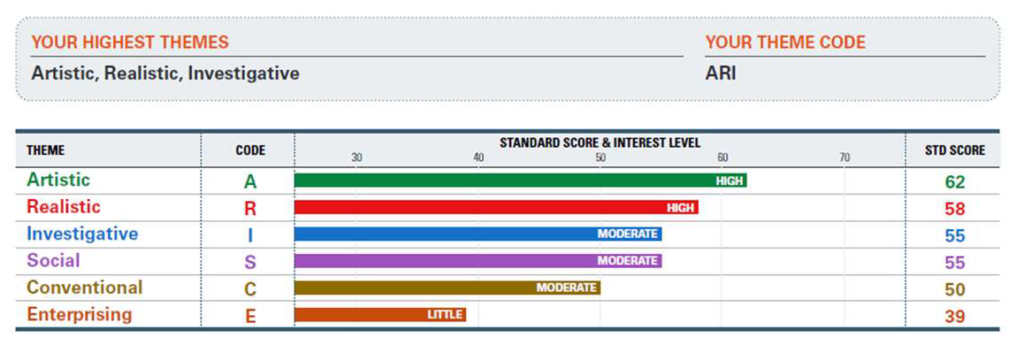
Page 3 lists the six General Occupational Themes (GOTs) in descending order of interest, each with a standard score and an interpretive comment such as “High,” “Moderate,” or “Little” (GS Consultants, 2023).
It is important to note that these are standard scores, not percentiles. Scores compare the respondent to the General Representative Sample (GRS), a norm group of about 100,000 people (GS Consultants, 2023; The Myers-Briggs Company, 2023). For example, a score of 62 indicates a higher interest in that theme than most people in the general population.
Take Alex, the sample respondent used throughout the Strong GS Consultants certification program. Alex’s theme code is ARI—Artistic (62), Realistic (58), and Investigative (55)—with Moderate scores in Social and Conventional, and a Little interest in Enterprising (39).
In practical terms:
• Alex shows a high interest in creative and hands-on work (Artistic and Realistic themes).
• He is about as interested as most people in research, helping others, and organizing information.
• He has little interest in selling, managing, or persuading (the Enterprising theme).
The GOT code follows a specific rule: the first theme is always included, while the second and third are included only if their standard scores are 50 or above (GS Consultants, 2023). Themes within the same interpretive category that differ by fewer than 5 points are considered a statistical tie and should be discussed with clients during interpretation.
Scale 2: Basic Interest Scales (BISs) — Page 4
If the GOTs are the wide-angle lens, the Basic Interest Scales (BISs) are the zoom. There are 32 BISs in total, each representing a narrower slice of interest within the six RIASEC themes—and two of them are brand new, added in 2023: Hospitality & Tourism (Social) and Conservation & Environmentalism (Investigative) (GS Consultants, 2023).
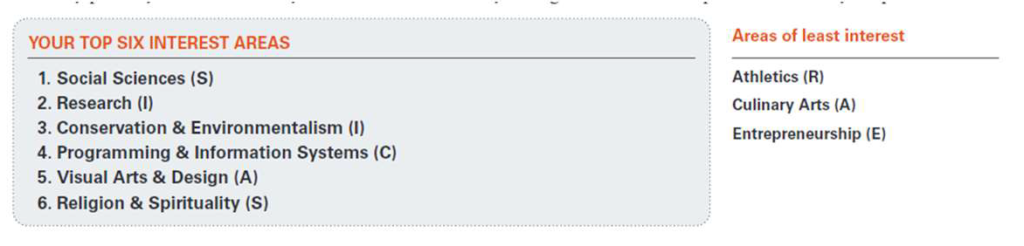
Page 4 lists the respondents’ top six BISs, their RIASEC codes, and their lowest BISs. BIS scores are standard scores compared to the GRS and use the same interpretive comment framework as the GOTs (GS Consultants, 2023).
Alex’s top BISs are Social Sciences, Research, Conservation & Environmentalism, Programming & Information Systems, Visual Arts & Design, and Religion & Spirituality, covering Social, Investigative, Conventional, and Artistic themes. His lowest are Athletics, Culinary Arts, and Entrepreneurship. Notably, his Programming & Information Systems BIS is 65, just below the “Very High” threshold, which is a valuable discussion point in career conversations (GS Consultants, 2023).
It is important to note that a respondent’s highest BISs may not always align with their top GOT. For example, a client may score high on the Artistic theme but have their highest specific interests in Research and Science, indicating an interest in creative problem-solving within a scientific context (GS Consultants, 2023). These patterns should be explored further.
Scale 3: Personal Style Scales (PSSs) — Page 5
While the GOTs and BISs focus on what you’re interested in, the Personal Style Scales (PSSs) explore how you prefer to work and learn. Page 5 presents six bipolar scales—each with a contrasting descriptor on either end—such as People–Things, Ideas–Data, and Learning Environment preferences (GS Consultants, 2023).
The scoring interpretation works like this (GS Consultants, 2023):
• Scores above 54 align with the descriptor on the right side of the scale.
• Scores below 46 align with the descriptor on the left.
• Scores between 46 and 54 suggest the respondent relates to aspects of both descriptors.
Alex’s PSSs indicate a preference for balancing work with people and things, favouring ideas over data, and learning best in academic, book-based environments (score of 69). He leads by example, is a cautious risk-taker, and thrives as part of a work team (score of 71) (GS Consultants, 2023). These preferences provide valuable context for career planning beyond job titles.
Scale 4: Occupational Scales (OSs) — Pages 6 and 11–17
Many clients find the Occupational Scales particularly engaging. The Strong® includes 243 Occupational Scales, each developed by sampling individuals who are satisfied and successful in their respective occupations (GS Consultants, 2023; The Myers-Briggs Company, 2023).
This is a critical interpretive distinction: unlike the GOTs and BISs, the Occupational Scales do not compare the respondent to the general population. Instead, they compare the respondent’s interests to those of satisfied workers in each specific field (GS Consultants, 2023). If a respondent’s score is high on a given occupational scale, it means they answered the Strong similarly to people who work in—and enjoy—that occupation.
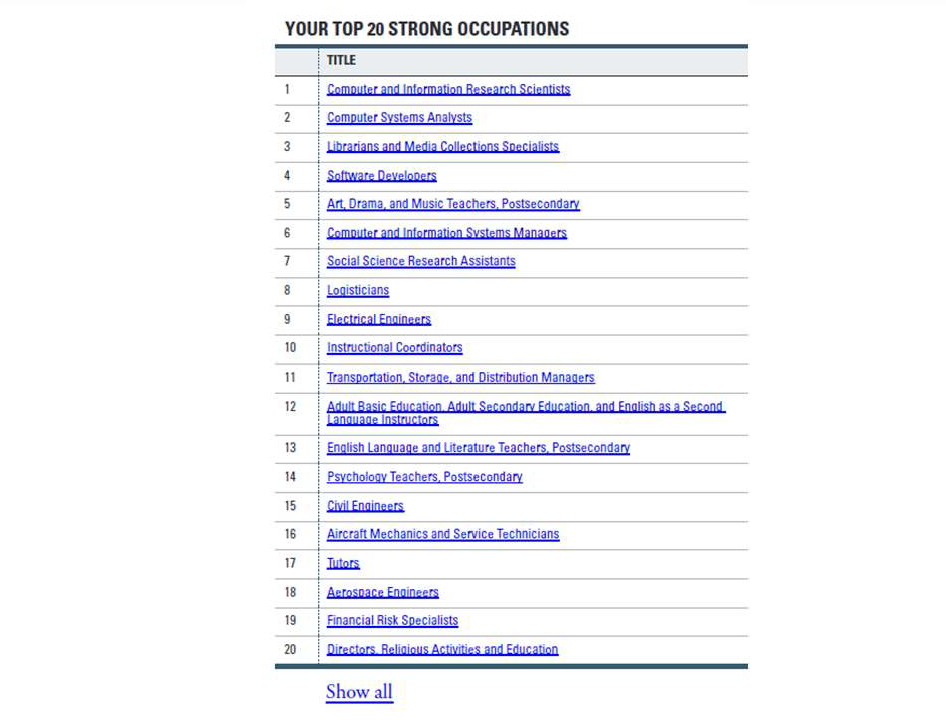
Page 6 lists the respondent’s top 20 Occupational Scales, each with three data points:
• Satisfaction Score: A probability score reflecting how likely the respondent is to feel satisfied in that occupation.
• Similarity Score: A measure of how similarly the respondent responded to the Strong compared to workers in that occupation.
• Stars (0–3): Awarded based on the combination of both scores. More stars indicate a stronger overall match (GS Consultants, 2023).
Alex’s top occupations include Computer and Information Research Scientists, Computer Systems Analysts, Librarians and Media Collections Specialists, and Software Developers, all earning three stars. All occupational titles in the PDF report are hyperlinked to O*NET Online, providing instant access to job descriptions, required skills, salary data, and related occupations (GS Consultants, 2023).
The full list of 243 occupations, ranked by stars and descending Similarity Scores, is included in the report appendix on pages 11–17.
A Bonus Scale: The Majors Scales — Pages 7–8
Particularly useful for students and those considering a career change that involves going back to school, the Majors Scales appear on pages 7 and 8. This section covers 33 areas of academic study and uses the same Satisfaction Score, Similarity Score, and star system as the Occupational Scales (GS Consultants, 2023).
Alex’s top-starred majors are Area/Ethnic/Cultural/Gender & Group Studies, Social Sciences, Theology and Religious Vocations, and History, all earning three stars. These results reflect his broad intellectual curiosity beyond his current software engineering career.
Putting It All Together
The value of the Strong lies in considering all four scales together, rather than in isolation. The GOTs identify broad interest areas, the BISs highlight specific interests, the PSSs reveal preferred work and learning styles, and the Occupational and Majors Scales translate these insights into actionable career and education options.
The report emphasizes that the Strong measures interests, not abilities, and that career development is an ongoing process (GS Consultants, 2023). Assessment results should be viewed as a starting point for exploration. When used thoughtfully, the Strong Career Satisfaction Report is a comprehensive tool for workplace self-understanding.
In the next post, we will examine scales, scores and administrative indexes and discuss how to explain them to clients in an accurate and empowering way.
References
GS Consultants. (2023). Strong certification program: Module 3—The Strong report & introduction to standard scores [Presentation notes]. Psychometrics Canada.
The Myers-Briggs Company. (2023). Strong244 technical supplement. https://strongsupplement.themyersbriggs.com/
Holland, J. L. (1997). Making vocational choices: A theory of vocational personalities and work environments (3rd ed.). Psychological Assessment Resources.
Find a Complete Sample Strong Interest Inventory® Profile with High School Profile here from Psychometrics Canada.
—
Disclosure: This post is part of an ongoing series reflecting the author’s updated expertise following participation in the GS Consultants certification program through Psychometrics Canada. Multiple AI tools were used as a productivity tool to assist with analysis, organization, and writing.