



Highlights:
- In the third quarter of 2025, permit expirations reached a record 339,505, while only 163,026 new permits were issued.
- More than 40% of permanent residents admitted in 2025 were already in Canada as temporary residents.
- The projection is that by 2036, one in three Canadians could be foreign-born, up from one in five now.
Md Asiuzzaman
For the first time in decades, Canada’s population shrank, with more than 76,000 people leaving in just the third quarter of 2025 (Statistics Canada, 2025). This transition from growth to decline was not accidental. It reflects a major policy shift toward more balanced, managed growth, rather than the rapid expansion observed in recent years.
With projections showing that by 2036, one in three Canadians could be foreign-born (Statistics Canada, 2017), understanding this policy change is important for anyone interested in Canada’s future.
Canada is recognized as one of the world’s most successful multicultural countries, welcoming approximately 250,000 newcomers annually and maintaining strong social cohesion despite its growing diversity (Picot, 2011). The number reached 400,000 in 2013 and then again in 2021. But 2025 marks a turning point in Canadian immigration, with the potential to change the country’s future and challenge its multicultural identity.
Admission Target 2026
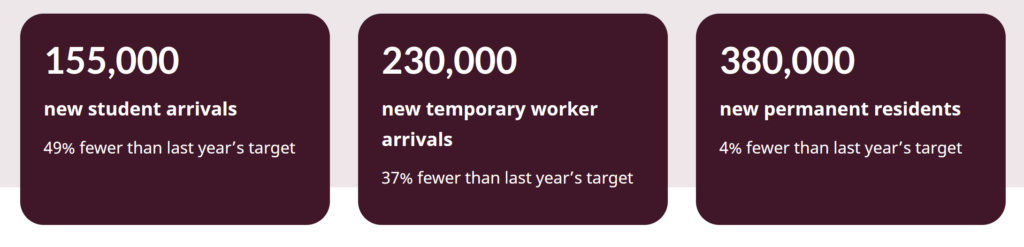
The 2025 Immigration Policy Revolution: From Growth to Long-term Sustainability
Understanding the Numbers
The 2025 immigration policy change is one of the biggest shifts in Canada’s recent immigration history. After years of raising immigration targets and admitting record numbers of temporary residents, the government now plans to sharply reduce the non-permanent resident (NPR) population. The aim is to lower the number of temporary residents to only 5% of the total population by the end of 2026 (Statistics Canada, 2025).
The data tells a persuasive story. In the third quarter of 2025, permit expirations reached a record 339,505, while only 163,026 new permits were issued. This represents a complete reversal of previous trends, in which temporary residents peaked in October 2024 and began a steady decline (Statistics Canada, 2025).
Permanent resident admissions are still high, with about 395,000 targeted for 2025, the same number planned for 2026, and a small increase to 400,000 in 2027 (Immigration, Refugees and Citizenship Canada, 2025). This indicates that Canada is not ending immigration but is changing who can enter and under what conditions.
What Drove This Dramatic Change?
Several factors led to this policy change. Housing has become unaffordable in many big Canadian cities, where most newcomers live. Healthcare systems are under greater pressure than ever, and public services are struggling to keep up with population growth.
The rapid rise in temporary residents, particularly international students and temporary foreign workers, has generated tensions that could threaten the social cohesion Canada has built over many years.
More than 40% of permanent residents admitted in 2025 were already in Canada as temporary residents (Statistics Canada, 2025). This ‘two-step immigration’ method confers an advantage on individuals with Canadian work experience and education, thereby facilitating their integration while also controlling the total number of newcomers.

Canada’s Immigration Landscape: Past, Present, and Future
Historical Background: From Exclusion to Inclusion
Understanding Canada’s current immigration challenges calls for examining how dramatically the system has evolved. Toronto, Canada’s largest city and primary destination for newcomers, serves as an excellent microcosm of this change (CanadaFAQ.ca, 2015).
Before 1941 and through the 1950s, most immigrants to Canada came from Europe. In the 1960s and 1970s, more people arrived from the Americas, escaping wars and crises in the United States, Central America, and South America. The most significant change began in the 1980s, when immigration from Asia increased rapidly—a trend that continues (CanadaFAQ.ca, 2015).
By 2011, this change was clear. Of the 248,660 newcomers that year, most were from Asia, especially the Philippines, India, and China. The breakdown of immigration categories showed Canada’s focus: 63% Economic Class (skilled workers), 23% Family Class (family reunification), and 11% Refugee Class (CanadaFAQ.ca, 2015). The trend continues in 20025.

The 2036 Vision: A Fundamentally Different Canada
Statistics Canada projects a major demographic shift that will change Canadian society (Statistics Canada, 2017). Currently, approximately one in five Canadians is foreign-born. By 2036, just over a decade from now, that number will be one in three.
These changes mean more than just new statistics:
Religious Diversity: The proportion of Canadians practicing non-Christian religions will nearly double, from 9% to between 13-16%, with significant increases among Muslims, Hindus, and Sikhs (Statistics Canada, 2017).
Visible Minorities: Over one-third of the working-age population—potentially as high as 40%—will be visible minorities, fundamentally changing workplace relations and cultural norms (Cain, 2017).
Regional Origins: Over half of the immigrant population will come from Asian countries, while European immigration will be cut in half, from about 30% to approximately 15% (Statistics Canada, 2017).
Language Profile: Between 26% and 30% of Canadians will have a mother tongue other than English or French, up from 20% today. English will become even more common as the main official language (75-78%), while French will drop slightly to 21-23% (Cain, 2017).
Geographic Concentration: Most immigrants continue to settle in Canada’s three largest cities—Toronto, Montreal, and Vancouver—leading to markedly different experiences of multiculturalism across the country (Statistics Canada, 2017).
The Secret to Canada’s Success: Seven Pillars of Social Cohesion
What makes Canada’s immigration story remarkable isn’t just the numbers—it’s the nation’s ability to preserve social cohesion despite rapid diversification. Research from Statistics Canada identifies seven key factors that explain this success (Picot, 2011):
1. No Single Canadian Identity
Unlike nations built around a monolithic national identity, Canada has never developed a dominant cultural narrative. This paradoxically makes it easier to accommodate diversity, as there’s no single “Canadian way” that newcomers must adopt.
2. Immigration as Natural
Canadians see immigration not as a threat, but as a normal and important part of the country’s growth and progress. This view is supported by education and public policy.
3. Positive Perceptions
Most Canadians born in Canada hold a positive view of newcomers. They see them as well-educated, skilled professionals who contribute to society, not as competitors for resources.
4. Government Support
All levels of government—municipal, provincial/territorial, and federal—actively promote immigration, creating policy coherence rarely seen in other countries.
5. Civic Engagement
Newcomers participate in political and community life, engaging in government activities and helping to build their communities.
6. Diverse Origin
Because newcomers come from diverse backgrounds, no single ethnic group constitutes the majority of immigrants. This helps prevent the rise of a ‘majority minority’ situation that could cause tension.
7. Low Unauthorized Immigration
Compared to the United States and some European countries, Canada maintains relatively low levels of unauthorized immigration, reducing social tensions and policy conflicts.
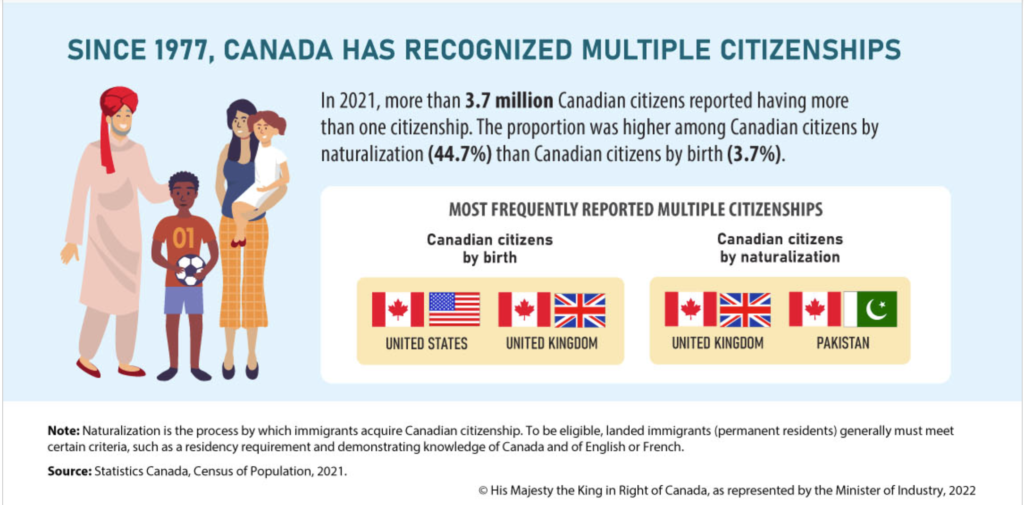
Critical Questions for Canada’s Future
As Canada goes through this major policy change, several important questions come up:
- Can Canada maintain social cohesion as its population changes rapidly? So far, the country has done well, but having one-third of the population foreign-born is new territory. Will the seven factors that have supported unity still work at this scale?
- Is the 2025 policy change temporary, or will it remain in place? Reducing the number of temporary residents temporarily eases housing and service pressures, but because Canada has more deaths than births, immigration is still needed to maintain population stability and support the economy.
- What happens to smaller communities? With immigration increasingly concentrated in three major cities, how can smaller communities access the demographic and economic benefits of immigration while developing the infrastructure to support newcomers?
- How will institutions adjust? Schools, workplaces, healthcare, and government services must adapt to serve a more diverse population with diverse languages, religions, and cultures.
Conclusion: Navigating Uncertainty with Evidence and Sympathy
Canada is at a turning point in 2025. The move to reduce the number of temporary residents and manage growth is a practical response to real problems, such as housing shortages, healthcare strain, and limited service capacity. But it also brings uncertainty for the many international students and temporary workers who came to Canada expecting something different.
The path to 2036 won’t be straightforward. Balancing economic demands with humanitarian duties, managing urban concentration while supporting smaller communities, and preserving social cohesion amid rapid demographic change will call for careful policy, sustained political will, and continued public support for immigration.
Canada’s situation is unique because of the strong foundation it has built. The seven factors that support social unity did not happen by accident—they are the result of years of policy decisions, public education, and cultural growth. As Canada enters this new phase, these foundations will face challenges, but they need not fail.
The question isn’t whether Canada will remain a nation of immigrants—demographic realities ensure it will. The question is whether Canada can manage this transition wisely, retaining the social unity and multicultural success that have become its hallmark while tackling legitimate concerns about pace, scale, and sustainability.
For international students, prospective immigrants, policymakers, and Canadians, understanding these changes is not merely of interest—it is essential for navigating life in a more diverse Canada. The choices made now will shape not only who lives in Canada in 2036, but also what kind of country it will be.
(Research disclosure: Multiple AI tools are used in research, analysis and writing this article.)
References
Asiuzzaman, M. (2026, February 12). Week 5: Immigration – Future (Unit 2: Immigration – past, present, & future) [PowerPoint slides]. Multiculturalism: The Canadian Diversity Project. Conestoga College. D2L Brightspace. https://conestogac.on.ca
Cain, P. (2017, January 25). What Canada’s population will look like in 2036. Global News. http://globalnews.ca/news/3204538/what-canadas-population-will-look-like-in-2036/
CanadaFAQ.ca. (2015). Canadian immigration facts & statistics. http://www.canadafaq.ca/canadian-immigration-facts.php
Immigration, Refugees and Citizenship Canada. (2025). 2025-2027 immigration levels plan. Government of Canada. https://www.canada.ca/en/immigration-refugees-citizenship/corporate/reports-statistics/statistics-open-data.html
Picot, G. (2011). The effect of immigration on social cohesion in Canada (Analytical Studies Branch Research Paper Series). Statistics Canada. https://www150.statcan.gc.ca/n1/pub/11f0019m/2008319/s13-eng.htm
Statistics Canada. (2017, January 25). Study: A look at immigration, ethnocultural diversity and languages in Canada up to 2036, 2011 to 2036. The Daily. https://www150.statcan.gc.ca/n1/daily-quotidien/170125/dq170125b-eng.htm
Statistics Canada. (2025, December 17). Canada’s population estimates, third quarter 2025. The Daily. https://www150.statcan.gc.ca/n1/daily-quotidien/251217/dq251217b-eng.htm