



Md Asiuzzaman
Canada leads the developed world in educational attainment. Approximately 57.5% of working-age adults hold college or university credentials, placing Canada first among G7 nations (OECD, 2025). In provinces such as Ontario and British Columbia, more than one-third of adults hold bachelor’s degrees or higher (USCA Academy, 2025). By any measure, Canadians are among the most educated people in the world.
However, this achievement conceals a significant paradox: as more Canadians obtain degrees, the value of these credentials diminishes. This era of credential inflation is characterized by educational requirements for jobs rising faster than job complexity, resulting in qualified individuals struggling to secure employment commensurate with their qualifications. According to Embark (2024), the average cost of a four-year university education in Canada is projected to reach $101,319 in 2025. However, this traditional pathway to career success now offers increasingly unpredictable returns.

Understanding Credential Inflation
Credential inflation occurs when educational requirements for positions increase even though job complexity, duties, or pay remain unchanged (College Grant Hub, 2025). Entry-level positions that once required high school diplomas now demand bachelor’s degrees. Jobs previously filled by bachelor’s degree holders increasingly prefer candidates with master’s degrees or specialized certifications. The bar keeps rising, but the destination remains essentially the same.
This phenomenon generates a self-reinforcing cycle. As the number of degree holders rises, employers increasingly use credentials as screening tools, elevating educational requirements even when not warranted by job complexity. According to The Hub, many Canadians with post-secondary credentials end up working in jobs unrelated to their field of study, suggesting that job seekers continue to pursue additional qualifications, thereby contributing to a cycle of rising educational requirements with limited returns.
Statistical data illustrate the magnitude of this shift. Among Canadians aged 25-34, 14% now hold master’s degrees or equivalent qualifications, up from 11% in 2019 (OECD, 2025). Although this growth in advanced credentials appears positive, employment opportunities have not kept pace. According to the Labour Market Information Council, job openings in Canada for positions requiring a bachelor’s degree and less than three years of experience have fallen by more than half since early 2024.
Canada’s Educational Attainment: A Double-Edged Sword
The numbers paint a striking picture. In Ontario, 62.8% of adults aged 25 to 64 possess a college or university credential, with 36.8% holding bachelor’s degrees or higher, the highest rates in Canada (USCA Academy, 2025). British Columbia follows closely, with 58.1% holding postsecondary credentials and 35% holding bachelor’s degrees or higher.
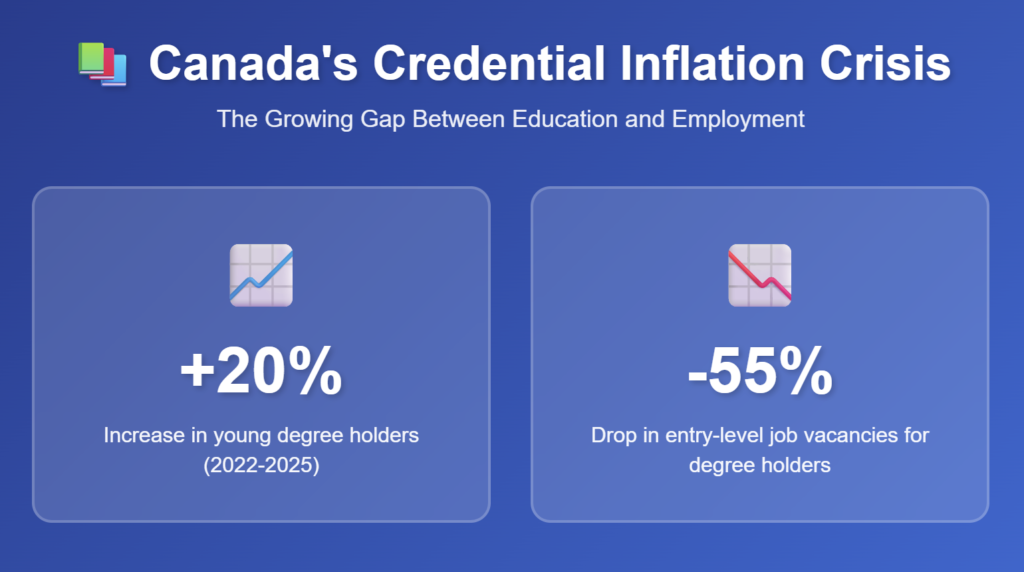
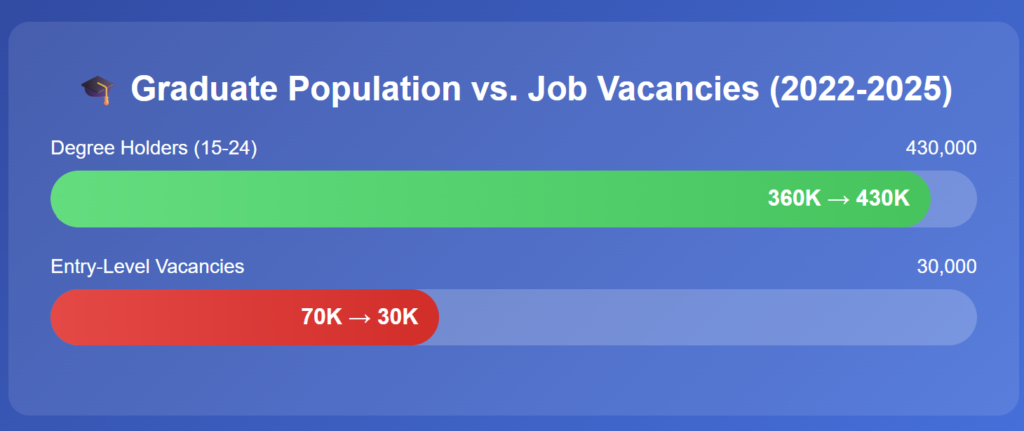
Among young adults aged 25-34, Canada leads the OECD, with 14% holding master’s degrees or equivalent, up from 11% in 2019 (OECD, 2025). However, this educational expansion has created a supply-demand mismatch. The population of young Canadians aged 15-24 with bachelor’s degrees has never been higher, yet job vacancies requiring these credentials have plummeted by more than 55% since early 2024 (Nelson & Yang, 2025; Statistics Canada, 2025).
The Immigrant Paradox: Highly Qualified, Systematically Underemployed
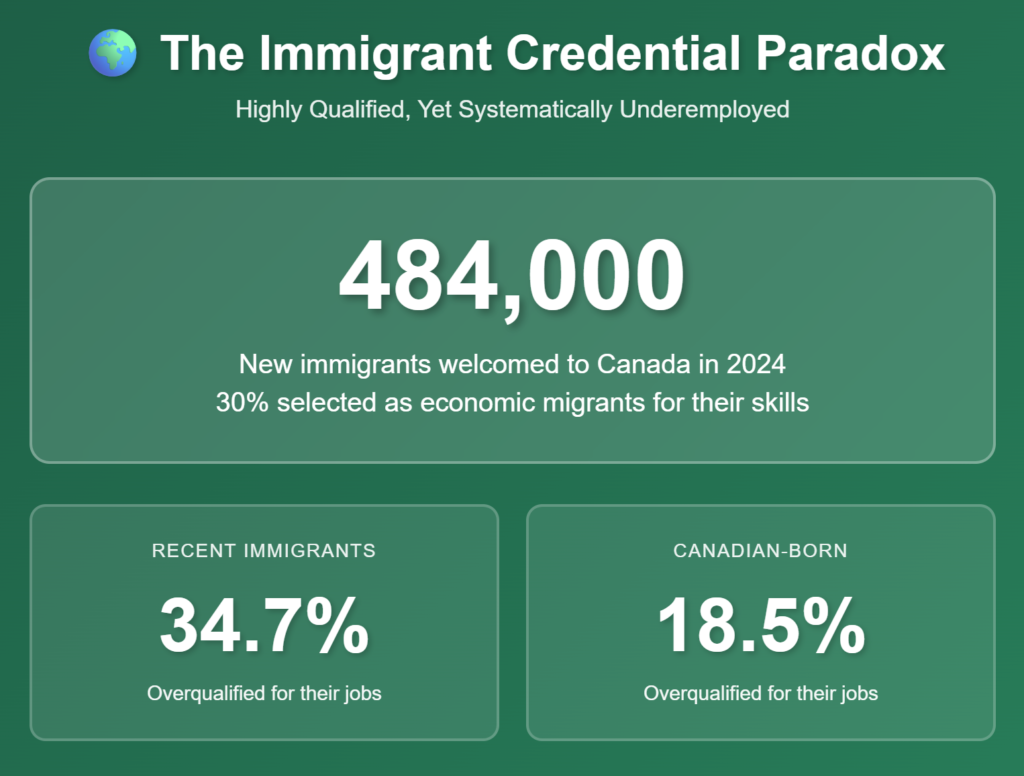
While domestic credential inflation creates challenges for Canadian-born workers, the situation for skilled immigrants is particularly acute. Canada welcomed approximately 484,000 new immigrants in 2024, of whom 30% were economic migrants selected for their skills and qualifications (OECD, 2025). However, despite being selected for their credentials, these highly educated newcomers face systemic barriers that exacerbate the effects of credential inflation.
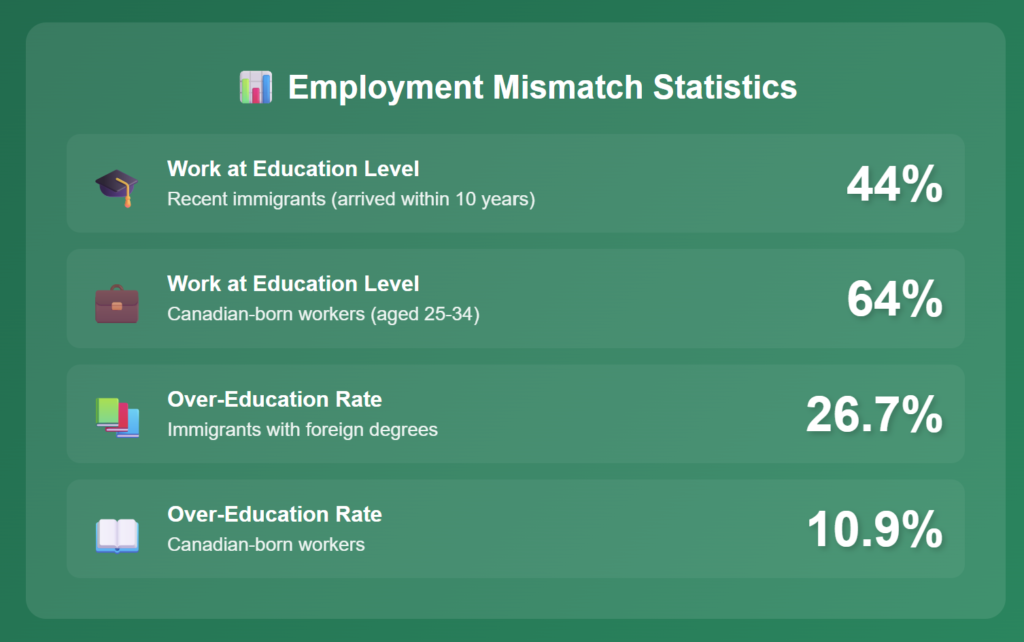
The overqualification crisis among immigrants is staggering. In 2021, only 44% of immigrants who had arrived in the previous decade held jobs that matched their education level, compared with 64% of Canadian-born workers aged 25-34. The over-education rate among university graduates employed in jobs requiring less than a bachelor’s degree was 26.7% among immigrants, more than double the 10.9% rate among Canadian-born workers (Akbar & Triandafyllidou, 2025). In September 2025, recent immigrants reported that 34.7% were overqualified for their current roles, compared to just 18.5% of Canadian-born workers (ImmigCanada, 2025).
Approximately two-thirds of recent immigrants hold degrees from foreign institutions, and their overeducation rate is 24 percentage points higher than that of younger Canadian-born workers with comparable qualifications (Akbar & Triandafyllidou, 2025). This substantial pool of overqualified workers significantly alters labour market dynamics. According to Statistics Canada, between 2001 and 2016, the Canadian workforce increased by 1.7 million people with a bachelor’s degree or higher. However, only half of these individuals were employed in high-skilled occupations.
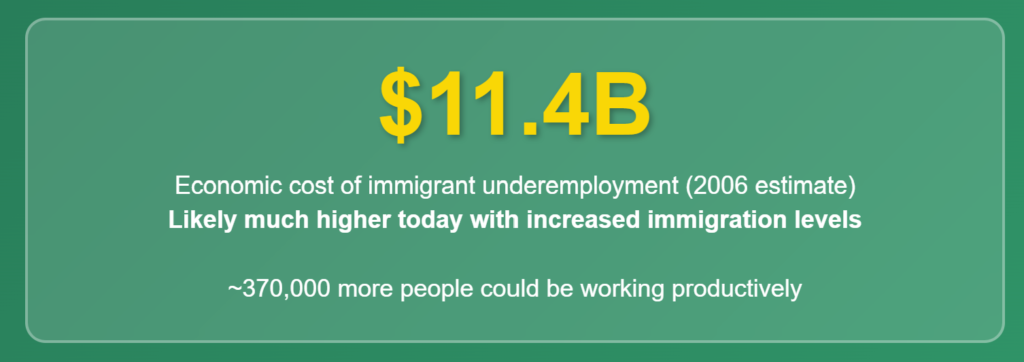
When many degree holders take jobs that require only high school credentials, this can displace workers with appropriate qualifications and raise educational expectations for similar roles in the future. This trend can result in significant economic consequences. Research estimates that immigrant underemployment cost Canada $11.4 billion in 2006 (in 2011 dollars), and with higher immigration levels today, this loss is likely much greater (WES, 2025). The underutilization represents not just individual tragedy but systemic economic inefficiency. The same analysis suggests that raising immigrant employment rates to match those of non-immigrants would result in approximately 370,000 additional people working productively.
Several structural barriers drive immigrant underemployment. Despite being illegal in Ontario, many employers require Canadian experience, creating a Catch-22 in which newcomers cannot gain local experience without already having it. Credential recognition remains complex, costly, and time-consuming, particularly for regulated professions. Language barriers persist even for technically proficient immigrants. According to the OECD, many skilled individuals can be overlooked for job opportunities due to mismatches between how they present their skills and how employers recognize and interpret these qualifications.
The Supply Surge: Demographics and Policy Choices
Credential inflation tends to intensify when the number of qualified workers increases more rapidly than the available job opportunities. Multiple factors drive Canada’s surge in credential supply. International student enrollment increased 170% over the past decade, reaching 468,000 students in 2022-2023 (Conference Board of Canada, 2025). While these students contribute institutional revenue and cultural diversity, their addition to graduate populations intensifies competition.
Domestic enrollment patterns compound the problem. The population of young Canadians aged 15-24 with bachelor’s degrees increased approximately 20% between 2022 and 2025, from roughly 360,000 to 430,000 (Nelson & Yang, 2025). Combined with immigrant credential-holders, this creates unprecedented competition for shrinking opportunity pools.
More than 40% of anticipated permanent resident admissions in 2025 will be from temporary residents already in Canada (Canada, 2024). While transitions from temporary to permanent status offer advantages, proven Canadian experience, and integration, they also mean credential-holders remain in the labour market longer, increasing competitive pressure on entry-level positions.
The Degree Premium Reversal
Perhaps the most shocking evidence of credential inflation appears in unemployment data. For decades, bachelor’s degree holders aged 15-24 have consistently experienced lower unemployment than their peers with non-bachelor’s credentials. Since 2023, this pattern has inverted. Young people with bachelor’s degrees now face higher unemployment rates than those with college or trades credentials (Statistics Canada, 2025c).
In September 2025, recent postsecondary graduates aged 20-29 with bachelor’s degrees or higher had an unemployment rate of 8.1%, up from 6.4% in 2022 and 5.9% in 2019 (pre-pandemic; Statistics Canada, 2025e). This reversal reflects fundamental shifts in labour demand. Certificate and diploma programs often lead to occupations that require hands-on skills resistant to automation, such as healthcare workers, electricians, plumbers, and HVAC technicians, who are more resilient than white-collar positions vulnerable to technological displacement (Canadian Apprenticeship Forum, 2024).
Technology’s Accelerating Impact
Technological advancement, particularly artificial intelligence, accelerates credential inflation by reshaping which skills employers value. According to a Statistics Canada report, from November 2022 to December 2025, employment growth in Canada varied by age: workers aged 30 to 49 experienced almost 30 percent higher employment in coding-intensive jobs, whereas employment for those aged 15 to 29 remained nearly unchanged.
Generative AI is now capable of performing many entry-level tasks, including drafting documents, summarizing reports, writing basic code, and conducting preliminary analysis (Smith, 2024; Mehdi & Morissette, 2024). As a result, employers increasingly question the need to hire inexperienced graduates for tasks that algorithms can perform efficiently, preferring experienced professionals to oversee AI systems (Levanon et al., 2025). According to Statistics Canada, job vacancies in business, finance, and administration fell by 4.7 percent in early 2025, while related sectors, such as sales and service occupations, also experienced declines.
Breaking the Cycle: Comprehensive Reform
Addressing credential inflation requires systemic changes. First, credential recognition for immigrants must become faster, cheaper, and more transparent. Ontario’s recent removal of Canadian experience requirements for electricians, engineers, and plumbers represents progress, but health care, where nurse aides show the highest overqualification rates, remains excluded (CERIC, 2022).
Second, cultural biases favouring university degrees must give way to genuine respect for trades and technical education. These pathways offer lower costs, faster employment, and access to resilient sectors yet remain undervalued.
Third, students need comprehensive labour market information that shows employment outcomes by field, credential, and institution to support informed decision-making (Nelson & Yang, 2025).
Fourth, employers should scrutinize whether credential requirements serve genuine needs or merely convenient screening. Skills-based hiring, work-integrated learning, and expanded internship programs offer alternatives. Enhanced partnerships between educational institutions and employers can provide Canadian work experience before graduation, thereby addressing the catch-22 faced by immigrants and recent graduates alike.
Finally, post-secondary institutions must be held accountable for employment outcomes, not just enrollment numbers. Recent international student reforms, including caps and enhanced quality metrics, represent important steps (Alfa Beta Global, 2025), but domestic programs require similar scrutiny.
Conclusion
Canada’s credential inflation crisis results from multiple converging factors, including increased domestic enrollment, rising numbers of international students, underemployment among skilled immigrants, technological displacement, and employer screening practices that emphasize credentials over competencies. When bachelor’s degree holders experience higher unemployment than college graduates, 34.7% of recent immigrants work below their qualifications, and entry-level vacancies decline by 55% despite increasing graduate numbers, the system demonstrates significant shortcomings. The system is designed to recruit skilled immigrants for economic benefits, then systematically prevents them from contributing fully. Meanwhile, domestic students invest more than $100,000 in credentials that offer deteriorating returns. This dual waste, underutilized immigrant talent and overpriced domestic credentials, represents economic and human tragedy.
Addressing this cycle requires a willingness to challenge prevailing assumptions about the value of education, to implement substantive reforms to credential recognition, to diversify pathways to success, and to hold institutions accountable for employment outcomes. While university degrees continue to offer long-term benefits, they are neither essential for all careers nor sufficient to guarantee success. Comprehensive reform is necessary to ensure that educational investments, whether obtained in Canada or abroad, yield meaningful returns for all qualified job seekers who contribute to Canadian society.
(Research Disclosure: The blog is part of my ongoing research on Career Development. I used AI-assisted technologies for data synthesis, thematic analysis, and editorial support throughout the development of this article.)
References
Akbar, M., & Triandafyllidou, A. (2025, February 18). Canadian immigrants are overqualified and underemployed; reforms must address this. The Conversation. https://theconversation.com/canadian-immigrants-are-overqualified-and-underemployed-reforms-must-address-this-247974
Alfa Beta Global. (2025, January 31). The future of international education in Canada: Trends and predictions for 2025 and beyond. https://www.alfabetaglobal.com/blogs/the-future-of-international-education-in-canada-trends-and-predictions-for-2025-and-beyond
Canada. (2024, October 24). 2025-2027 Immigration Levels Plan. Immigration, Refugees and Citizenship Canada. https://www.canada.ca/en/immigration-refugees-citizenship/news/2024/10/20252027-immigration-levels-plan.html
Canadian Apprenticeship Forum. (2024). Apprentice demand in Red Seal trades: A 2024 national labour market information report. https://caf-fca.org/research_reports/executive-summary-apprentice-demand-in-red-seal-trades-a-2024-national-labour-market-information-report/
CERIC. (2022, June 14). Canada’s essential yet overqualified immigrant workforce. https://ceric.ca/2022/06/canadas-essential-yet-overqualified-immigrant-workforce/
College Grant Hub. (2025, June 27). Credential inflation: What it is and how to navigate it. https://collegegranthub.com/blog/credential-inflation-what-it-is-and-how-to-navigate-it/
Conference Board of Canada. (2025, January 27). Higher education trends. https://www.conferenceboard.ca/focus-areas/education-skills/higher-education-trends/
Embark. (2024, December 10). Cost of university education set to rise to $101,319 in 2025. https://www.embark.ca/learning-centre/cost-of-university-education
ImmigCanada. (2025, October 17). Canada’s job market rebounds with 60,000 new jobs in September 2025. https://immigcanada.com/canadas-job-market-rebounds-with-60000-new-jobs/
Levanon, G., Sigelman, M., Mamertino, M., de Zeeuw, M., & Guilford, G. (2025). No country for young grads: The declining value of a college degree in the U.S. The Burning Glass Institute. https://www.burningglassinstitute.org/research/no-country-for-young-grads
Mehdi, T., & Frenette, M. (2026). Canadian employment trends in the era of generative artificial intelligence: Early evidence. Economic and Social Reports, 6(01). Statistics Canada. https://doi.org/10.25318/36280001202600100003-eng
Mehdi, T., & Morissette, R. (2024). Experimental estimates of potential artificial intelligence occupational exposure in Canada (Analytical Studies Branch Research Paper Series, Catalogue no. 11F0019M). Statistics Canada. https://www150.statcan.gc.ca/n1/pub/11f0019m/11f0019m2024005-eng.htm
Nelson, P., & Yang, B. (2025, October 2). Eligible bachelors: Canada’s newest university graduates face an increasingly challenging job market. Labour Market Information Council. https://lmic-cimt.ca/eligible-bachelors-canadas-newest-university-graduates-face-an-increasingly-challenging-job-market/
OECD. (2025). International Migration Outlook 2025: Canada. https://www.oecd.org/en/publications/2025/11/international-migration-outlook-2025_355ae9fd/full-report/canada_5a18453c.html
Smith, M. (2024). Insights on generative AI and the future of work. North Carolina Department of Commerce (Labor & Economic Analysis). https://www.commerce.nc.gov/news/the-lead-feed/generative-ai-and-future-work
Statistics Canada. (2025a). Table 14-10-0443-01: Job vacancies, proportion of job vacancies and average offered hourly wage by occupation and selected characteristics, quarterly, unadjusted for seasonality. https://www150.statcan.gc.ca/t1/tbl1/en/tv.action?pid=1410044301
Statistics Canada. (2025b). Table 14-10-0020-01: Unemployment rate, participation rate and employment rate by educational attainment, annual. https://www150.statcan.gc.ca/t1/tbl1/en/tv.action?pid=1410002001
Statistics Canada. (2025c, October). Youth faced a challenging labour market in the summer and into September. https://www.statcan.gc.ca/o1/en/plus/8640-youth-faced-challenging-labour-market-summer-and-september
USCA Academy. (2025, October 9). Canada education rate 2025: Key stats & trends. https://www.uscaacademy.com/blog/canada-education-rate/
WES. (2025, October 8). Canada’s evolving immigration priorities in 2025. https://www.wes.org/resource-library/blog/global-mobility/beyond-the-numbers-canadas-shifting-immigration-priorities/